The landscape of education is undergoing a fundamental transformation. We are moving away from passive learning models where students simply memorize facts. Instead, the focus is shifting toward active creation, problem solving, and technical fluency. To support this shift, educational institutions must provide physical spaces that foster innovation. A dedicated lab is no longer a luxury. It is a necessity for preparing students for the future workforce.
Setting up a functional and inspiring workspace requires careful planning. It involves more than just buying equipment. It requires a strategic vision that aligns with educational goals. This guide provides a comprehensive roadmap for a successful STEM lab setup. We will explore how to design, equip, and sustain a Robotics and AI lab in education that serves students effectively.
Defining the Vision for Your STEM Lab Setup and Robotics and AI Lab in Education
Before purchasing a single piece of equipment, school administrators and educators must define the purpose of the lab. A clear vision ensures that the investment delivers real value to the students.
You should consider what skills you want to develop. Some institutions focus heavily on coding and software. Others prioritize mechanical engineering and physical prototyping. The most effective labs often blend these disciplines. They create an environment where computer science meets the physical world.
Key questions to address during this phase include:
- Which age groups will use the lab?
- Will the lab support core curriculum or extracurricular clubs?
- What is the available budget for initial setup and ongoing maintenance?
- How will the lab support STEM innovation labs globally and connect students to wider trends?
The Core Components of STEM Lab Setup and Robotics and AI Lab in Education
A modern lab is more than a room with tables. It is a piece of smart education infrastructure designed to be flexible and adaptive. The physical layout significantly impacts how students collaborate and learn.
Traditional classroom rows do not work in an innovation lab. The space needs to encourage movement and teamwork.
Consider these layout elements for an optimal STEM lab setup:
- Flexible Furniture: Use tables on wheels and stackable chairs. This allows the room to be reconfigured quickly for different projects.
- Zoned Areas: Create distinct zones for different activities. You might have a “clean” zone for coding and design, and a “dirty” zone for fabrication and assembly.
- Storage Solutions: clear bins and labeled cabinets are essential. Robotics kits involve thousands of small parts. varied storage keeps the space usable.
- Power and Connectivity: Ensure there are abundant power outlets. Drop-down power sources from the ceiling can be very effective for keeping floors clear of cables.
Essential Equipment for STEM Lab Setup and Robotics and AI Lab in Education
The heart of any lab is the technology students use to build and experiment. Selecting the right tools can be overwhelming due to the sheer volume of options available.
A successful Robotics and AI lab in education requires a tiered approach to equipment. You need tools that cater to beginners while offering depth for advanced learners. Solutions from partners like Maker and coder are valuable here because they offer scalable kits that grow with the students’ abilities.
Here is a checklist of essential equipment categories:
- Computational Hardware
High performance laptops or tablets are the control center of the lab. They are necessary for coding, 3D design, and running simulations. Ensure these devices meet the specifications for the software you intend to use. - Robotics Construction Kits
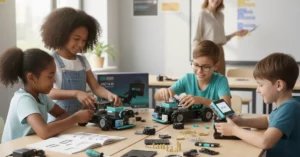
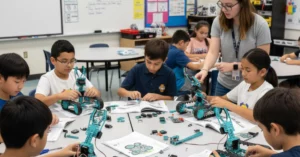
These are the core building blocks of the curriculum. You need modular kits that allow students to assemble mechanisms, attach sensors, and program movements. Maker and coder provides kits that range from simple mechanical builds to complex, sensor driven autonomous units. - Artificial Intelligence Tools
AI education is moving from theory to practice. Your lab should include cameras for computer vision projects, voice recognition modules, and microcontrollers capable of running machine learning algorithms. - Prototyping and Fabrication Tools
Students need to build the bodies of their robots and structures for their projects. 3D printers and laser cutters are standard in STEM innovation labs globally. They allow students to turn digital designs into physical objects in minutes. - Electronics Stations
Designate an area for circuitry. This should include soldering irons, multimeters, breadboards, and a wide supply of sensors, LEDs, and jumper wires.
Implementing Curriculum and Structured Learning
A room full of expensive equipment will sit unused without a structured curriculum. The hardware must serve the learning outcomes. This is where many schools struggle. They invest in the “stuff” but not the “strategy.”
Effective STEM lab setup involves integrating the tools into daily lessons. It is not enough to have a “robotics Friday.” These concepts should be woven into math, science, and even art classes.
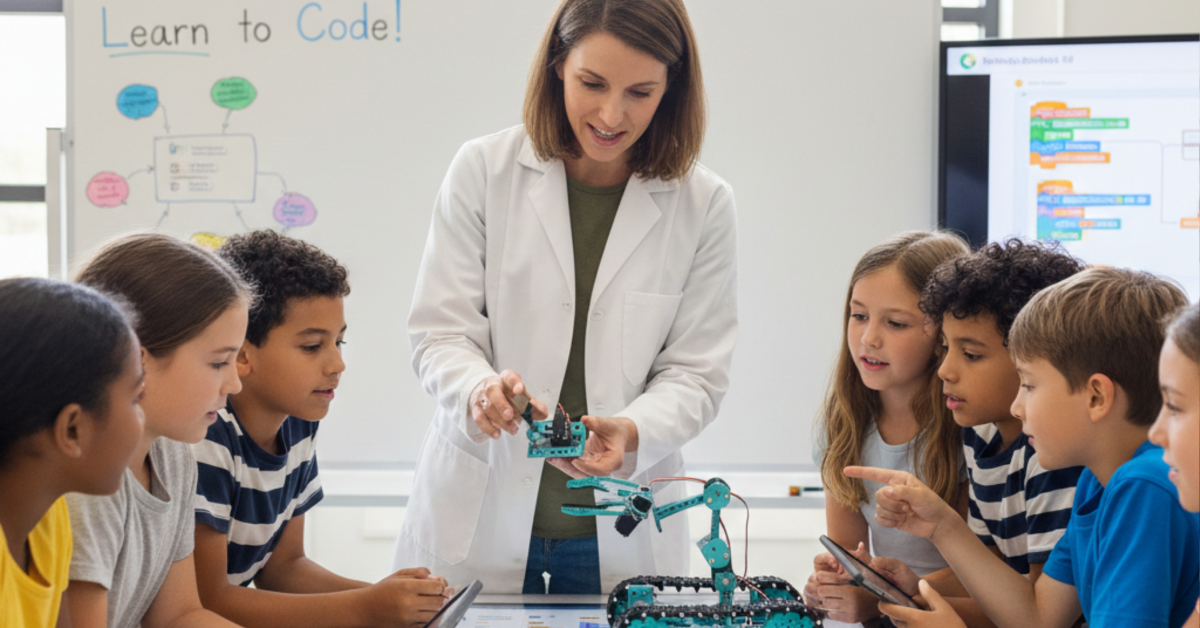
Maker and coder helps bridge this gap by offering curriculum aligned kits. These resources provide teachers with lesson plans, project guides, and assessment rubrics. This support allows educators to focus on teaching rather than inventing new technical projects from scratch.
A robust curriculum integration plan includes:
- Scaffolded Projects: Start with simple guided builds to build confidence. Gradually introduce open ended challenges that require original design.
- Real World Application: Connect projects to global issues. Ask students to design robots that can clean oceans or AI systems that can sort recycling.
- Cross Disciplinary Links: Use the robotics lab to demonstrate physics concepts like torque and friction. Use coding lessons to teach logic and algebra variables.
Teacher Training and Professional Development
The most critical asset in a STEM lab is the teacher. You cannot expect educators to instinctively know how to operate 3D printers or debug Python code. Comprehensive training is vital.
Schools must invest in professional development alongside equipment purchases. This ensures that teachers feel confident and competent. When teachers are comfortable with the technology, they are more likely to use it creatively.
Effective training strategies include:
- Hands on Workshops: Teachers should build the projects before the students do. This helps them anticipate common problems.
- Peer Collaboration: Encourage science, math, and technology teachers to plan units together.
- Ongoing Support: utilize support channels from vendors. Maker and coder provides resources that help teachers troubleshoot and expand their knowledge base.
Global Trends in STEM Lab Setup Worldwide
Education is a global enterprise. To remain competitive, schools must look at STEM lab setup worldwide. Institutions across Asia, Europe, and the Americas are raising the standard for technical education.
International STEM lab setup trends show a move toward:
- Integration of AI: Schools are moving beyond basic coding to teaching machine learning concepts.
- Sustainability Focus: Labs are increasingly focused on green technology and sustainable engineering.
- Collaborative Networks: Global STEM lab for schools initiatives often involve connecting classrooms across borders. Students in one country might collaborate on a design with peers on another continent.
By aligning your lab with these global standards, you ensure your students are prepared for an interconnected world.
Budgeting and Sustainability
Building a lab is a significant financial commitment. However, it is an investment in the institution’s future. Proper budgeting involves looking beyond the initial purchase price.
You must plan for:
- Consumables: 3D printer filament, batteries, and electronic components will need regular replacement.
- Maintenance: Equipment will break. Budget for repairs and replacements.
- Upgrades: Technology moves fast. Set aside funds to update software and hardware every few years.
Many schools successfully fund their labs through grants, alumni donations, and community partnerships. Demonstrating a clear plan for usage and curriculum integration often makes these funding proposals more successful.
Safety and Management Protocols
A lab filled with tools and electronics requires strict safety protocols. Student safety is paramount.
Essential safety measures include:
- Clear Signage: Label all safety zones and emergency stops.
- Safety Gear: Ensure there are enough safety glasses and protective equipment for the class size.
- training: Students must pass a safety certification for specific tools like laser cutters or soldering irons before they are allowed to use them.
Launching Your Lab
Once the equipment is in place and the teachers are trained, it is time to launch. Make the opening of the lab a celebration. Showcase the potential of the space to parents, students, and the community.
Host an open house where student leaders demonstrate the new Maker and coder robotics kits. Let parents try their hand at coding a simple program. This builds excitement and buy in from the entire school community.
Conclusion
Setting up a STEM, Robotics & AI lab is a complex but rewarding journey. It requires a balance of vision, investment, and pedagogical strategy. By focusing on flexible design, essential equipment, and strong curriculum support, schools can create environments where innovation thrives.
These spaces are where the next generation of engineers, scientists, and creators will find their passion. Whether you are a small rural school or a large university, the principles of STEM lab setup remain the same. Prioritize the learning, support the teachers, and provide high quality tools that inspire curiosity.
With the right approach and partners like Maker and coder, your institution can build a world class facility that prepares students not just for the exams of today, but for the challenges of tomorrow.