Smart classrooms in 2026 are setting new standards in education worldwide. Powered by advanced technology and innovative STEAM kits, these digital classrooms are shaping the next generation of learners. Maker and Coder is leading this transformation by making modern education technology accessible and engaging.
What Is a Smart Classroom in 2026?
Smart classrooms in 2026 blend connected devices, high-speed internet, and interactive platforms to create engaging digital classrooms. Schools are embracing smart classroom technology to:
- Personalize learning for each student.
- Integrate practical STEAM education tools.
- Foster collaboration, creativity, and problem-solving skills.
These environments are becoming the standard, not the exception, in modern education technology.
How STEAM Kits Are Powering Modern Education
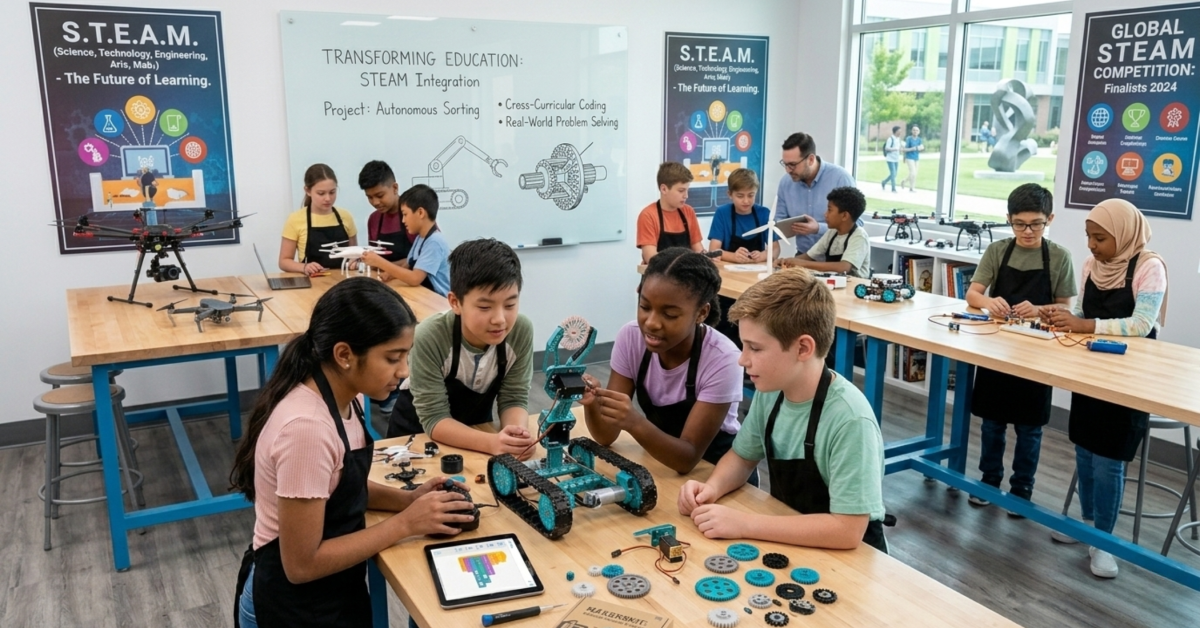
STEAM kits in education are hands-on learning sets that translate complex science, technology, engineering, and math concepts into real-world experiences. In a 2026 smart classroom, STEAM kits help students:
- Apply theories through meaningful projects.
- Develop critical thinking with practical tools.
- Gain confidence through guided experimentation.
Maker and Coder’s innovative STEAM education tools empower students from elementary to high school, allowing for creativity and deeper understanding across age groups and learning levels.
Examples of STEAM Kits in Action
- Robotics Kits: Teach mechanical and programming principles by letting students build and code robots.
- Electronics Kits: Use breadboards and sensors to help students master circuitry and electrical concepts.
- Coding Kits: Introduce students to block and text-based programming for games and applications.
- Science Experiment Kits: Make biology, chemistry, and physics tangible through water analysis, renewable energy models, and more.
In every case, STEAM kits transform theory into hands-on discovery, making knowledge stick and boosting classroom engagement.
Global Smart Classroom Trends in 2026
Smart classrooms are a global movement. Here’s what you’ll notice worldwide:
Personalized Learning
- AI-driven platforms adjust content to suit each student’s pace and skill level.
- Teachers provide targeted feedback based on real-time analytics.
Gamification & Immersive Tech
- Lessons gamified with points and badges to increase participation.
- Virtual and augmented reality create field trips and science labs without leaving the classroom.
Collaborative Learning
- Digital classrooms break down borders—students everywhere work together on shared STEAM projects.
- Teams develop solutions and present findings just like professionals.
The Future of Global Education: International STEAM Integration
International collaboration is key for the future of global education. Technology erases geographical boundaries, allowing classrooms from different countries to partner on projects, especially in STEAM.
Key Benefits:
- Cultural Exchange: Students gain global awareness by working with international peers.
- Diverse Problem-Solving: Teams bring unique perspectives to challenges.
- Global Citizenship: Learners develop solutions to world issues, from climate change to health.
Many schools participate in cross-border STEAM initiatives, sharing resources and ideas through digital platforms powered by smart classroom technology.
Maker and Coder: Shaping the Future with STEAM Kits
Maker and Coder’s mission is clear: empower students with the confidence and skills to succeed in a high-tech world. Our STEAM kits are crafted for seamless integration into smart classroom technology. We help educators bring lessons to life with hands-on resources aligned with modern education needs.
The journey to fully realized smart classrooms is ongoing:
- Schools invest in infrastructure and teacher training.
- Curricula are redesigned around creativity, critical thought, and global awareness.
- STEAM kits act as the bridge from passive learning to active engagement.
The future of education is bright. With smart classrooms in 2026, supported by the latest in STEAM education tools, students everywhere can reach their full potential.
How does Maker and Coder support smart classrooms?
Maker and Coder creates high-quality, scalable STEAM kits that align with smart classroom technology, empowering educators to inspire and prepare students for success in the digital age.
Education is undergoing a profound transformation. The traditional model of rows of desks facing a blackboard is rapidly being replaced by dynamic, interactive learning environments. Welcome to the era of smart classrooms. By 2026, these technologically advanced spaces are not just a luxury but a necessity for preparing students for the future. Central to this evolution are STEAM kits, which are fundamentally changing how students engage with science, technology, engineering, and mathematics.
This shift isn’t just about adding gadgets to a room; it’s about a complete pedagogical change. We will explore how smart classrooms in 2026 are leveraging modern education technology to create immersive learning experiences. You’ll discover the pivotal role of STEAM education tools, examine global smart classroom trends, and see how international STEAM integration is shaping the future of global education.
The Evolution into Digital Classrooms
The concept of a smart classroom has evolved significantly. It began with interactive whiteboards and projectors, but today it encompasses a fully integrated ecosystem of hardware and software. Smart classroom technology now includes high-speed internet, cloud computing, artificial intelligence, and a wide array of connected devices. This digital infrastructure creates a flexible and personalized learning environment.
In 2026, these digital classrooms are more connected than ever. AI-powered platforms can adapt curriculum in real-time based on a student’s performance, providing tailored support or more advanced challenges. Teachers are no longer just lecturers; they are facilitators of learning, guiding students through collaborative projects and hands-on discovery. This environment fosters critical thinking, problem-solving, and creativity—skills essential for the modern workforce.
The classroom is no longer confined by four walls. Cloud-based learning management systems allow students to access materials, submit assignments, and collaborate with peers from anywhere. This flexibility supports various learning styles and paces, making education more inclusive and effective. The future of education in 2026 is defined by this blend of physical and virtual learning spaces.
The Central Role of STEAM Kits in Education
While smart classroom technology provides the foundation, STEAM kits provide the spark. These kits are collections of tools and components designed for hands-on learning in science, technology, engineering, and mathematics. They turn abstract theories into tangible, interactive experiences. From building simple circuits to programming complex robots, STEAM kits make learning engaging and memorable.
Maker and Coder is at the forefront of this movement, providing high-quality STEAM education tools that empower students to become creators and innovators. Our kits are designed to be intuitive and scalable, catering to learners from elementary school through high school. They bridge the gap between theoretical knowledge and practical application, which is crucial for deep understanding.
Consider the impact. A student can read about aerodynamics in a textbook, or they can use a STEAM kit to design, build, and test their own drone. This hands-on process solidifies their understanding of physics principles in a way that passive learning never could. STEAM kits in education are not just about teaching subjects; they are about teaching a way of thinking. They encourage experimentation, perseverance through failure, and the joy of discovery.
From Theory to Practice: How STEAM Kits Work
STEAM kits demystify complex subjects by breaking them down into manageable, hands-on projects. Here’s how they transform the learning process:
- Robotics Kits: Students learn principles of mechanical engineering, electronics, and programming by building and coding their own robots. They see firsthand how lines of code translate into physical movement, teaching cause and effect in a powerful way.
- Electronics Kits: With components like breadboards, resistors, and LEDs, students can explore the fundamentals of circuitry and electrical engineering. They can build everything from a simple light to a sensor-driven alarm system.
- Coding Kits: These tools often use block-based or text-based programming languages to teach computational thinking. Students can create their own games, animations, and applications, developing logical reasoning and problem-solving skills along the way.
- Science Kits: Focused on biology, chemistry, or physics, these kits allow students to conduct experiments that bring scientific principles to life. They might analyze water samples, build a miniature ecosystem, or explore renewable energy sources.
These STEAM education tools make learning an active pursuit rather than a passive one. Students are not just consuming information; they are creating, testing, and iterating. This process builds confidence and nurtures a lifelong love of learning.
Global Smart Classroom Trends for 2026
The adoption of smart classroom technology is a worldwide phenomenon, though its implementation varies by region. As we look at global smart classroom trends, several key themes emerge that highlight the direction of modern education.
Personalized Learning at Scale
One of the most significant trends is the move toward personalized learning. AI algorithms can analyze student data to identify learning gaps and strengths, allowing teachers to provide individualized support. Adaptive learning platforms present content in a way that matches each student’s pace, ensuring no one is left behind or held back. This is a far cry from the one-size-fits-all approach of the past.
Gamification and Immersive Technologies
To keep students engaged, educators are increasingly turning to gamification—incorporating game-like elements such as points, badges, and leaderboards into lessons. This makes learning more enjoyable and motivates students to master new concepts.
Furthermore, immersive technologies like Virtual Reality (VR) and Augmented Reality (AR) are becoming more common in smart classrooms worldwide. A history class can take a virtual tour of ancient Rome, or a biology class can dissect a virtual frog. These experiences provide a level of engagement and understanding that traditional methods cannot match.
Collaborative and Project-Based Learning
The future of education in 2026 is collaborative. Smart classroom technology facilitates teamwork, whether students are in the same room or across the globe. Cloud-based documents, video conferencing, and digital collaboration tools allow students to work together on complex projects. This mirrors the collaborative nature of the modern workplace and prepares students for future careers. STEAM kits are often at the center of these projects, requiring teams to pool their skills to design and build a final product.
The Future of Global Education and International STEAM Integration
The interconnectedness of our world demands a global perspective on education. Technology is breaking down geographical barriers, allowing for unprecedented levels of international collaboration. This is particularly evident in the push for international STEAM integration.
Initiatives are underway to create global standards for STEAM education and to facilitate cross-cultural projects. Imagine a classroom in the United States collaborating with a classroom in Japan to design a solution for a shared environmental problem. Using shared digital tools and STEAM kits, students can work together, share ideas, and learn from each other’s unique perspectives.
This international STEAM integration offers several key benefits:
- Cultural Exchange: Students gain a deeper appreciation for different cultures and ways of thinking.
- Diverse Problem-Solving: Teams with diverse backgrounds often arrive at more creative and robust solutions.
- Global Citizenship: It fosters a sense of shared responsibility for global challenges like climate change, public health, and sustainable development.
The future of global education is one where collaboration knows no borders. Smart classrooms in 2026 will serve as hubs for this international exchange, with STEAM at the core of many collaborative efforts.
Maker and Coder: Equipping the Next Generation
At Maker and Coder, we believe that every student deserves the opportunity to become a confident, capable creator. Our STEAM kits are designed to integrate seamlessly into the modern smart classroom, providing the hands-on tools necessary to bring learning to life. We are committed to supporting educators as they navigate the transition to these new models of teaching.
The journey toward fully realized smart classrooms is ongoing. It requires investment in technology, ongoing professional development for teachers, and a commitment to a curriculum that prioritizes skills like critical thinking, collaboration, and creativity. STEAM kits are not just a component of this new educational landscape; they are a catalyst for it. They empower students to move from passive consumers of information to active participants in their own learning.
The future of education is bright, and it’s happening now. Smart classrooms in 2026 are dynamic, engaging, and personalized spaces of discovery. By embracing modern education technology and placing powerful STEAM education tools in the hands of students, we can prepare them for a future we can only begin to imagine.
Frequently Asked Questions
A smart classroom is a learning environment that uses technology to enhance education. It integrates tools like interactive whiteboards, high-speed internet, and connected devices to create a more dynamic, engaging, and personalized learning experience for students.
STEAM kits provide hands-on tools for learning science, technology, engineering, and mathematics. Students use them to build projects like robots or simple circuits, turning abstract concepts into tangible experiences. This active learning process helps develop critical thinking and problem-solving skills.
Smart classrooms in 2026 feature an ecosystem of technologies including AI-powered learning platforms, cloud computing for remote access, and immersive tools like Virtual Reality (VR) and Augmented Reality (AR). These technologies work together to create adaptive and collaborative learning environments.
Project-based learning encourages students to apply their knowledge to solve real-world problems. It promotes teamwork, creativity, and perseverance. Using tools like STEAM kits for these projects helps solidify understanding and prepares students for the collaborative nature of the modern workplace.
Smart classroom technology allows for personalized learning paths. AI can adjust the curriculum to a student’s individual pace, while digital resources offer information in various formats. This flexibility ensures that education is more inclusive and effective for students with diverse learning needs.
International STEAM integration involves students from different countries collaborating on STEAM projects. By using shared digital tools and platforms, they can work together to solve global challenges, fostering cultural exchange and developing a broader perspective on problem-solving.
Author Bio
Maker and Coder
Maker and Coder is dedicated to revolutionizing education through the integration of smart classroom technology and hands-on STEAM kits. By bridging the gap between theoretical knowledge and practical application, they empower educators and students to embrace innovation, creativity, and collaboration. With a mission to prepare learners for a tech-driven future, Maker and Coder continues to lead the way in transforming classrooms into dynamic hubs of discovery and growth.