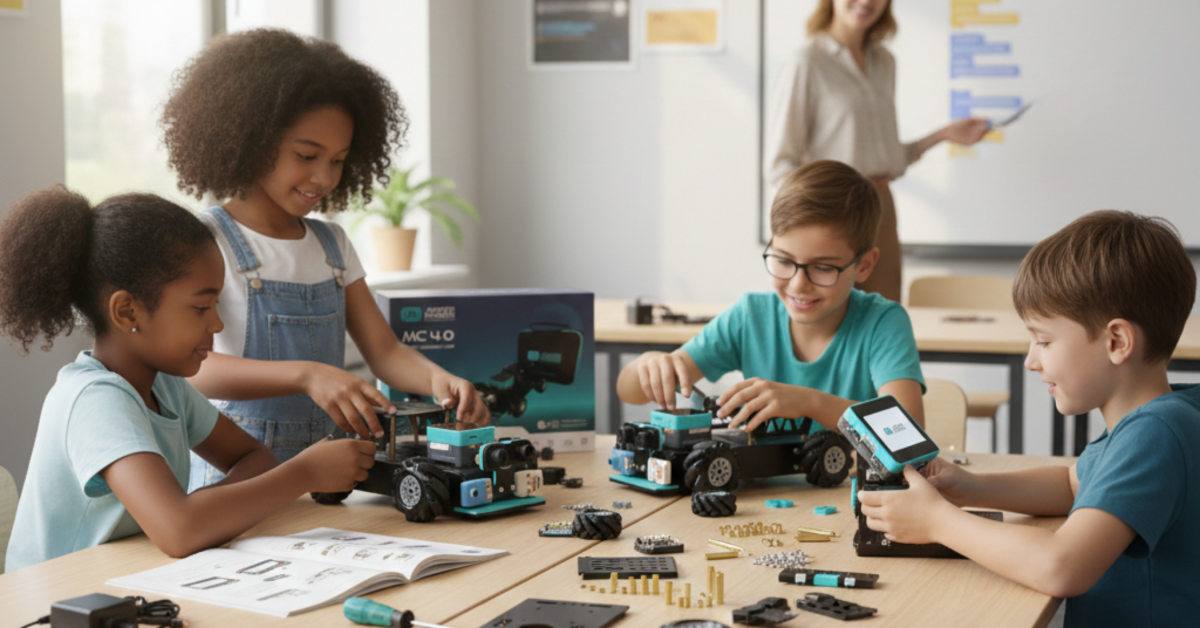
Imagine a classroom where students aren’t just memorizing formulas but are actively building the future. They are soldering wires, debugging code, and cheering as a mechanical arm successfully picks up a ball. This isn’t science fiction; it is the reality of modern learning environments that have embraced the power of technology. Robotics in education is no longer a niche elective. It has become a crucial pillar of learning that transforms passive listeners into active innovators.
At Maker and Coder, we see this transformation every day. When students get their hands on tangible technology, the abstract concepts of math and science suddenly click. This post explores why robotics is reshaping education, how it benefits learners, and why schools worldwide are racing to integrate these tools into their curricula.
The Shift from Textbooks to Tinkering: Robotics in Education
Traditional education often struggles to bridge the gap between theory and application. Students might learn the physics of torque or the logic of loops, but they rarely see it in action. Robotics-based education solves this problem by rooting learning in the physical world.
When a student programs a robot to navigate a maze, they are doing much more than playing with a toy. They are applying geometry to calculate angles, physics to determine speed, and logic to structure their code. This is the essence of experiential STEM learning. It moves education away from rote memorization and toward deep, conceptual understanding.
Why Hands-On Learning Matters
Research consistently shows that active learning strategies lead to better retention. When students build, test, and refine a robot, they engage multiple senses. They learn through trial and error a critical component of the scientific method that is often missing from standard lectures.
This hands-on approach also democratizes success. In a traditional classroom, the “best” students are often those with the strongest memory. In a robotics lab in schools, success comes from persistence, creativity, and collaboration. A student who struggles with written tests might excel at mechanical design, finding a new avenue for academic confidence.
Core Benefits of Robotics in Education
Integrating robotics into the classroom offers advantages that go far beyond learning how to code. It cultivates a mindset geared toward innovation and resilience.
1. Fostering Critical Thinking and Problem-Solving
Robots rarely work perfectly on the first try. A wheel might be loose, a sensor might be miscalibrated, or the code might have a bug. In these moments of failure, real learning happens.
Students must diagnose the problem, hypothesize a solution, and test it. This iterative process builds resilience. They learn that failure isn’t the end of the road but a necessary step toward success. This problem-solving capability is a skill that transfers to every other subject and future career path.
2. Enhancing Creativity and Innovation
Coding and robotics education is inherently creative. There is rarely only one way to solve a robotics challenge. One student might design a robot with tracks for stability, while another uses wheels for speed. One might write a complex algorithm, while another finds a simple, elegant loop.
This freedom allows students to experiment and innovate. They aren’t just following instructions; they are inventing solutions. By encouraging this creative thinking early, we prepare students for a workforce that values innovation over instruction-following.
3. Preparation for the Future Workforce
The World Economic Forum predicts that automation and AI will reshape the job market globally. Familiarity with technology is no longer optional. Robotics for students globally serves as an essential introduction to the languages of the future: programming, engineering, and data analysis.
Even if a student doesn’t become a robotics engineer, the computational thinking skills they acquire are invaluable. Understanding how systems work, how to break down complex problems, and how to communicate with machines are universal skills for the 21st century.
The Global Impact of Robotics in Education
The push for STEM isn’t isolated to one region. We are seeing a surge in educational robotics for schools worldwide. From tech hubs in Silicon Valley to emerging classrooms in Southeast Asia, educators recognize that robotics is a universal language.
Bridging the Digital Divide
Access to technology can be a great equalizer. An international Robotics curriculum for students ensures that learners from diverse backgrounds have access to the same high-quality tools and concepts. When schools invest in these resources, they level the playing field, giving every child a chance to participate in the digital economy.
At Maker and Coder, we believe that talent is distributed equally, but opportunity is not. By engaging in robotics-based education, schools can uncover hidden talents in students who might otherwise be left behind by the traditional academic system.
Building Global Collaborators
Robotics competitions often bring students together from different countries. These events highlight the power of robotics for students globally to foster collaboration. Students learn to communicate complex technical ideas across language barriers, united by their shared passion for engineering.
This global perspective is crucial. The biggest challenges of the future—climate change, space exploration, sustainable energy—will require international cooperation. Robotics teaches students early on that the best solutions often come from diverse teams working together.
Implementing a Robotics in Education Curriculum
For many schools, the barrier to entry isn’t interest; it’s implementation. How does a school go from zero to a fully functioning robotics program?
The Role of the Robotics Lab
Creating a dedicated robotics lab in schools is a game-changer. This space signals to students that innovation is a priority. It doesn’t need to be a high-tech facility akin to NASA. A dedicated room with workbenches, storage for kits, and computers for coding is a perfect start.
The lab becomes a sanctuary for curiosity. It is a place where “don’t touch” rules are replaced with “take it apart and see how it works.” This shift in environment is critical for fostering the Maker mindset.
Selecting the Right Curriculum
Not all robotics programs are created equal. An effective international Robotics curriculum for students must be scalable and age-appropriate.
- Early Elementary: Focus on simple mechanisms and sequence-based coding (no screens required).
- Middle School: Introduce block-based coding and more complex sensors.
- High School: Transition to text-based languages like Python or C++ and advanced mechanical engineering.
The curriculum should also be interdisciplinary. Robotics shouldn’t sit in a silo. It can be used to teach algebra (calculating distances), physics (forces and motion), and even art (designing robot aesthetics).
Overcoming Challenges in Robotics in Education Adoption
While the benefits are clear, schools often face hurdles when adopting coding and robotics education. Budget constraints and teacher training are common roadblocks.
Empowering Educators
You cannot have successful robotics in education without confident teachers. Many educators feel intimidated by technology they didn’t grow up with. Professional development is key. Schools need to provide training that focuses not just on how to use the robot, but how to teach with it.
Teachers should be facilitators, not just instructors. In a robotics classroom, it is okay for the teacher to say, “I don’t know, let’s figure it out together.” This shift in dynamic empowers students to take ownership of their learning.
Cost-Effective Solutions
Robotics doesn’t have to break the bank. There are many cost-effective kits available that offer high educational value. Furthermore, the investment pays dividends in student engagement. Schools can also look for grants or partnerships with local tech companies to fund their initial setup.
Case Studies: Success Stories in Robotics in Education
The impact of educational robotics for schools worldwide is best seen in the stories of the students themselves.
Consider a school that implemented a robotics program for at-risk youth. Initially, attendance was low, and engagement was poor. Once the robotics kits were introduced, attendance spiked. Students began staying after school to perfect their code. The robotics lab became a safe haven where they felt competent and in control.
In another instance, a high school physics class struggled with the concept of velocity and acceleration. The teacher introduced a project where students had to program a robot to complete a race in a specific time. By calculating the necessary speed and adjusting variables, abstract math became a concrete tool to win the race. Test scores on those concepts improved significantly.
These examples underscore the power of experiential STEM learning. It reconnects students with the joy of discovery.
The Future of Robotics in Education with Maker and Coder
As we look ahead, the integration of AI and machine learning into robotics kits will open new frontiers. Students will soon be training robots to recognize objects or navigate autonomously using neural networks.
Maker and Coder is committed to staying at the forefront of this evolution. We believe that robotics-based education is not a trend; it is the new standard for literacy in the digital age. It equips students with the technical skills to build the world they want to live in and the soft skills to navigate the challenges along the way.
Conclusion
The question is no longer if schools should teach robotics, but how fast they can implement it. Robotics in education offers a unique blend of academic rigor and creative freedom that traditional subjects struggle to match. It prepares students for a global economy, fosters critical thinking, and makes learning genuinely fun.
From setting up a robotics lab in schools to adopting a comprehensive international Robotics curriculum for students, every step taken is an investment in the future innovators of our world.
Are you ready to transform your classroom?
Actionable Next Steps
- Assess Your Needs: Determine the age group and skill level of your students to select the right equipment. Consider what STEM concepts you want to introduce—some kits are great for beginners, while others offer advanced features for older students.
- Start Small: You don’t need a full lab immediately. Start with a pilot program or an after-school club. This allows you to evaluate interest, troubleshoot challenges, and adjust your plans before scaling up.
- Invest in Training: Ensure your educators feel supported and confident with the new tools. Provide professional development opportunities and foster a culture of collaboration so teachers can share best practices and tips.
- Connect with Community: Look for local engineering firms or universities that can offer mentorship or sponsorship. Community industry partners can provide not only funding but guest speakers, real-world project ideas, and internship pathways.
- Explore Resources: Visit Maker and Coder to explore our range of educational tools and curriculum guides designed to spark innovation. Browse online communities, educational forums, and professional networks for additional support and inspiration.