The debate over the most effective STEAM education methods often centers on two approaches: traditional memorisation and modern project-based learning. While memorisation has long been a staple of schooling, project-based learning in STEAM is proving to be a more effective strategy for developing critical thinking, problem-solving skills, and a genuine passion for science, technology, engineering, and mathematics.
This article explores the comparison of memorisation vs project-based learning. We will analyze why active learning in STEAM, particularly through hands-on projects, prepares students for the challenges of the future. You will see how this shift reflects global STEAM education trends and shapes a more dynamic, skills-based education system worldwide.
Understanding the Core Educational Philosophies
To determine which method is superior, it’s essential to understand the fundamental differences between them. Each approach is built on a distinct philosophy about how students learn and what knowledge is most valuable.
What is Rote Memorisation?
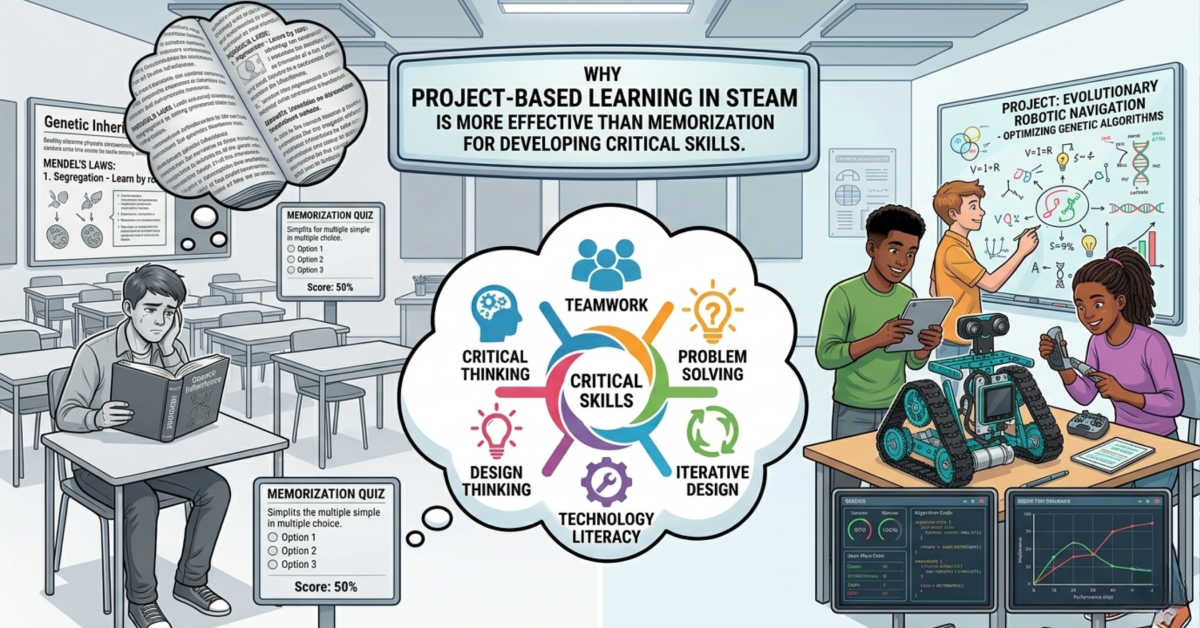
Rote memorisation is the process of learning information through repetition. In a STEAM context, this often involves memorizing formulas, definitions, and scientific facts without necessarily understanding their practical application. The primary goal is recall.
For decades, this method was the backbone of education. It’s a straightforward way to test a student’s ability to retain specific pieces of information. However, critics argue that it fails to teach students how to apply knowledge or think critically.
What is Project-Based Learning?
Project-based learning (PBL) is an active learning method where students gain knowledge and skills by working for an extended period to investigate and respond to a complex question, problem, or challenge. It is a form of experiential learning in education that puts students in the driver’s seat.
Instead of passively receiving information, students engage in inquiry-based learning. They ask questions, find resources, and apply their knowledge to create a tangible outcome or solution. This hands-on STEAM education approach makes learning relevant and engaging.
The Limitations of Memorisation in STEAM
Memorisation has its place; certain foundational concepts must be committed to memory. However, relying on it as the primary teaching method in STEAM has significant drawbacks that can hinder a student’s long-term success.
Surface-Level Understanding
The biggest issue with rote learning is that it often leads to a shallow understanding of complex topics. A student might be able to recite Newton’s three laws of motion but be unable to explain how they apply to a moving car or a rocket launch.
This lack of deep comprehension becomes a major obstacle in higher education and professional fields. STEAM careers demand problem-solvers, not just fact-reciters. The ability to connect concepts and apply theoretical knowledge to real-world scenarios is paramount.
Disengagement and Lack of Motivation
Constantly memorizing facts can be monotonous and uninspiring. When students don’t see the real-world relevance of what they are learning, they often become disengaged. This can stifle natural curiosity and lead to a negative perception of STEAM subjects.
Students may start to view science and math as a series of abstract rules to be memorized for a test, rather than as tools for understanding and shaping the world. This is a critical failure of modern teaching methods that rely too heavily on old techniques.
The Forgetting Curve
Information learned through rote memorisation is often quickly forgotten after an exam. The “forgetting curve,” a concept researched by psychologist Hermann Ebbinghaus, shows that we lose a significant amount of memorized information in a short time if we don’t use it.
Project-based learning combats this by embedding knowledge in experience. When a student uses a mathematical formula to design a bridge or a coding principle to build an app, the learning is reinforced through practical application, making it much more likely to be retained.
The Advantages of Project-Based Learning in STEAM
Project-based learning aligns perfectly with the core principles of STEAM. It encourages experimentation, collaboration, and innovation, mirroring the work of actual scientists, engineers, and tech innovators. This is a cornerstone of the future of STEAM education.
Developing 21st-Century Skills
PBL is highly effective at cultivating the skills necessary for success in the modern workforce. These are not just technical skills but also crucial soft skills that are in high demand across all industries.
Key skills developed through PBL include:
- Critical Thinking: Students analyze complex problems, evaluate information, and devise logical solutions.
- Problem-Solving: They learn to tackle open-ended challenges that don’t have a single right answer.
- Collaboration: Working in teams, students learn to communicate, delegate tasks, and integrate different perspectives.
- Creativity: PBL provides the freedom to innovate and approach problems from unique angles.
- Communication: Students must present their findings, justify their methods, and articulate their conclusions clearly.
Fostering Deeper Understanding
By engaging in hands-on STEAM education, students build a much deeper and more intuitive grasp of difficult concepts. Experiential learning in education helps bridge the gap between abstract theory and tangible reality.
For example, a student could learn about electrical circuits by reading a textbook. Or, they could build a simple robot. The second approach forces them to grapple with concepts like voltage, current, and resistance in a practical way, leading to a more robust and lasting understanding.
Increasing Engagement and Ownership
When students are given the autonomy to explore a topic they find interesting, their motivation soars. PBL gives students ownership over their learning journey. They are not just completing an assignment; they are creating something meaningful.
This sense of purpose is a powerful driver of engagement. It transforms learning from a passive chore into an exciting challenge, which is a key goal of modern teaching methods in STEAM.
The Role of Inquiry-Based Learning in PBL
Inquiry-based learning is the engine that powers effective project-based learning. It is a student-centered approach that starts with a question or a problem, rather than with the presentation of facts.
How Inquiry-Based Learning Works
In a PBL setting, a teacher might pose a broad challenge, such as: “How can we reduce our school’s energy consumption?” From there, students take the lead.
Their process might involve:
- Asking Questions: What are our biggest sources of energy use? What technologies exist for energy conservation?
- Investigating: Researching online, conducting interviews, and performing energy audits.
- Creating: Designing a solution, which could be a proposal, a prototype of a new device, or a public awareness campaign.
- Discussing: Collaborating with peers to refine ideas and solve problems.
- Reflecting: Analyzing their process and the success of their solution.
This cycle of inquiry and discovery is what makes PBL so effective. It teaches students how to learn, a skill that will serve them for the rest of their lives.
Global STEAM Education Trends and the Shift to PBL
The move towards project-based learning is not a localized phenomenon. It is a key part of global STEAM education trends, as countries around the world recognize the need to prepare their students for a rapidly evolving, technology-driven economy.
Skills-Based Education Worldwide
Nations are rethinking their educational systems to focus more on skills and competencies rather than on the simple acquisition of knowledge. Skills-based education worldwide prioritizes abilities like adaptability, digital literacy, and collaboration. Project-based learning is a perfect vehicle for this kind of education.
Countries like Finland and Singapore, often praised for their high-performing education systems, have been pioneers in incorporating PBL and other forms of active learning. They understand that the future of STEAM education lies in creating innovators, not just test-takers.
Preparing for the Future of Work
The jobs of tomorrow will require a high degree of creativity and problem-solving. Automation and AI are increasingly capable of handling routine, knowledge-based tasks. The human advantage lies in our ability to think critically, innovate, and work together on complex challenges.
By emphasizing project-based learning in STEAM, we are directly preparing students for this future. We are equipping them with the flexible, adaptable mindset they will need to thrive in a world of constant change.
Making the Switch: Project-Based Learning vs Memorisation
For educators and parents, the evidence is clear. While memorisation has a role, the future belongs to hands-on, inquiry-based approaches. The shift from memorisation vs project-based learning is a necessary evolution in how we teach STEAM.
What Does This Mean for Students?
For students, this means a more engaging, relevant, and empowering educational experience. It means less time spent on rote memorization and more time spent creating, building, and solving real problems. It’s an approach that sparks curiosity and builds confidence.
What Does This Mean for Educators?
For teachers, adopting PBL requires a shift in mindset from being a “sage on the stage” to a “guide on the side.” It involves creating a learning environment that encourages exploration and tolerates failure as part of the process. Maker and Coder supports educators in this transition, providing resources and training to implement effective hands-on STEAM education.
Conclusion: Building the Future, One Project at a Time
The contest between project-based learning and memorisation has a clear winner in the context of modern STEAM education. While memorizing key facts remains useful, it is an insufficient foundation for the demands of the 21st century.
Project-based learning in STEAM is the superior approach because it fosters deep understanding, develops critical skills, and ignites a genuine passion for discovery. It is an active, engaging, and effective method that prepares students not just for an exam, but for a lifetime of learning and innovation. By embracing this dynamic approach, we can empower the next generation of scientists, engineers, and creators to build a better future.
Frequently Asked Questions
Memorisation focuses on repeating facts and formulas so you can recall them for a test. Project-based learning (PBL) involves actively exploring real-world problems and creating tangible solutions. Instead of just remembering information, PBL helps you understand exactly how to apply those concepts in real life.
While knowing basic facts is helpful, relying only on memorisation often leads to a shallow understanding. STEAM fields need active problem-solvers. If you simply memorize formulas, you will likely forget them shortly after an exam. More importantly, rote learning makes it difficult to apply knowledge to new, complex challenges.
PBL builds essential skills that go far beyond the classroom. When you engage in hands-on projects, you develop a much deeper understanding of the material. Key benefits include:
- Stronger critical thinking and problem-solving abilities
- Better teamwork and communication skills
- Higher personal engagement, since you have ownership over your work
- Long-term retention of complex scientific and mathematical concepts
Education systems worldwide are shifting away from standardized testing and moving toward skills-based education. Top-performing countries recognize that future careers require adaptability and creativity. By adopting PBL, schools are matching global trends to prepare students for a technology-driven economy.
Absolutely. Tomorrow’s careers will demand people who can innovate and adapt to rapid changes. Automation and AI can handle routine tasks, but human jobs will rely on creative problem-solving. By working on open-ended STEAM projects today, students build the exact flexible mindset they need to thrive in any future career.
Author Bio
Maker and Coder
The Maker and Coder team is dedicated to revolutionizing education through innovative STEAM methodologies. With a focus on project-based learning, they aim to inspire critical thinking, creativity, and problem-solving in students. By blending hands-on experiences with cutting-edge educational strategies, Maker and Coder empowers educators and learners to embrace the future of STEAM education. Their mission is to cultivate a generation of innovators ready to tackle real-world challenges.