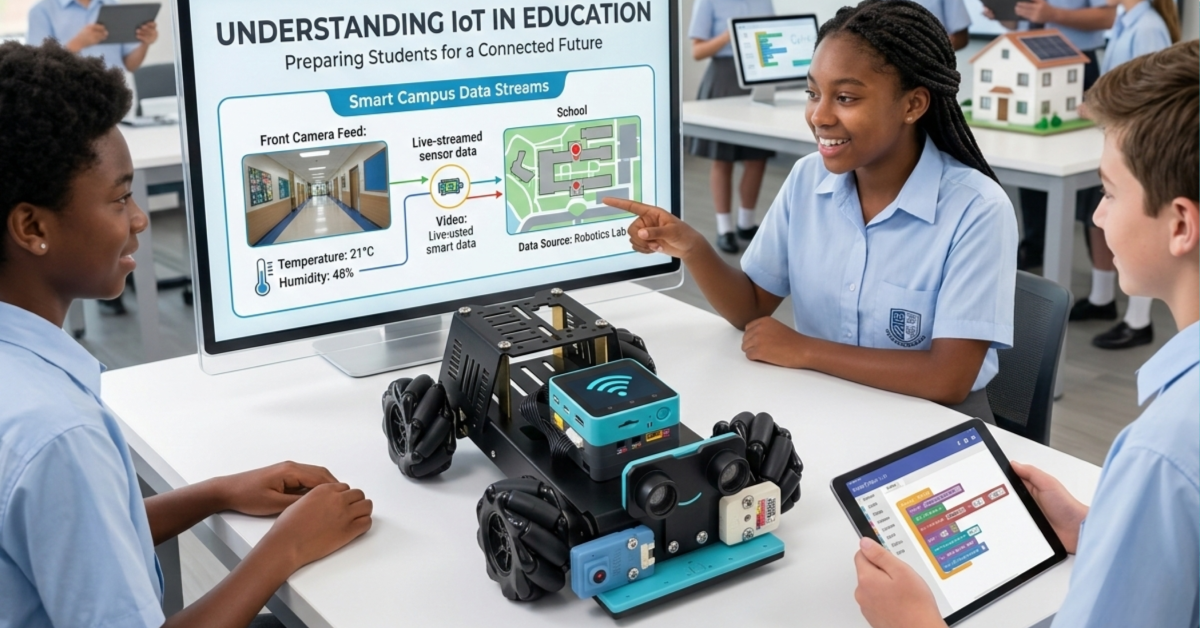
The Internet of Things, or IoT, is transforming how we interact with the world around us. From smart homes to connected cities, this technology is everywhere. Its arrival in education is opening doors for students to move beyond theory and engage in hands-on, practical learning. By integrating IoT in education, students are empowered to create real smart projects right in their classrooms.
This shift allows young learners to understand complex concepts through tangible creation. Hands-on STEAM education helps students build devices that solve real-world problems, preparing them for the jobs of tomorrow. This article explores how to bring the Internet of Things in classrooms and guide students in building their own smart projects. We will cover project ideas, the necessary tools, and the incredible benefits of this innovative approach.
What is IoT and Why is it Important in Schools?
The Internet of Things (IoT) refers to the vast network of physical devices embedded with sensors, software, and other technologies. These devices connect and exchange data with each other and with systems over the internet. Think of a smartwatch tracking your heart rate or a smart thermostat adjusting your home’s temperature.
The Significance of IoT Learning in Schools
Bringing IoT learning in schools is crucial for several reasons. It bridges the gap between abstract STEAM concepts and practical application. Students learn not just the “what” but the “how” and “why” behind technology. This hands-on experience is fundamental to developing critical thinking and problem-solving skills.
Moreover, the global workforce is increasingly demanding digital literacy. Exposure to IoT projects for students equips them with relevant skills in coding, data analysis, and engineering. It prepares them for future careers in a world dominated by smart technology and interconnected systems.
Getting Started: The Foundation for Classroom IoT Applications
Introducing IoT into the classroom doesn’t have to be overwhelming. With the right foundation, educators can create an environment ripe for innovation. It starts with accessible tools and a structured approach to learning.
Essential Tools and Technologies
To begin building smart classroom projects, students need a basic toolkit. These components are affordable, reusable, and designed for educational settings.
- Microcontrollers: These are the brains of any IoT project. Boards like Arduino and Raspberry Pi are popular choices due to their versatility and strong community support. They are easy to program and connect to various sensors.
- Sensors and Actuators: Sensors gather information from the environment (e.g., temperature, light, motion), while actuators perform actions (e.g., turning on an LED, moving a motor). A starter kit often includes a variety of these components.
- Connectivity Modules: To make a device “smart,” it needs to connect to the internet. Wi-Fi modules like the ESP8266 or ESP32 are excellent for enabling wireless communication in student projects.
- Programming Environment: Students will need software to write and upload code to their microcontrollers. The Arduino IDE and Python (for Raspberry Pi) are user-friendly and have extensive documentation.
- Cloud Platforms: IoT platforms like ThingSpeak, Blynk, or Adafruit IO allow devices to send data to the cloud for storage, visualization, and analysis. This is a key part of any true IoT application.
Simple IoT Projects for Students to Build
Once the tools are in place, students can start building. Beginning with simple projects helps build confidence and introduces core concepts gradually. These initial projects lay the groundwork for more complex STEAM IoT projects later on.
Project 1: The Smart Plant Monitor
A classic introductory project is the smart plant monitor. It teaches students about sensors, data collection, and automation in a relatable context.
Objective:
Build a device that monitors a plant’s soil moisture and alerts the user when it needs water.
Components:
- MC4.0 controller
- Soil moisture sensor
- Jumper wires
How it Works:
The soil moisture sensor is placed in the plant’s pot. The microcontroller reads the data from the sensor. If the moisture level drops below a certain threshold, the microcontroller triggers an actuator—either lighting up the LED or sounding the buzzer. This simple feedback loop is a fundamental concept in IoT.
Project 2: Classroom Environment Monitor
This project expands on the first by incorporating multiple sensors and introducing data visualization. It is a great example of practical classroom IoT applications.
Objective:
Create a system that monitors the classroom’s temperature and humidity and displays the data on a web dashboard.
Components:
- MC4.0 controller
- Temperature and humidity sensor
- An IoT cloud platform – MC Cloud
How it Works:
The sensor collects temperature and humidity data every few minutes. The microcontroller sends this data over Wi-Fi to a cloud platform. Students can then log into the platform from any computer to see real-time and historical data graphs, learning about environmental conditions and data logging.
Advancing to More Complex STEAM IoT Projects
After mastering the basics, students can take on more challenging projects. These advanced ideas encourage them to think critically about system design, data analysis, and user interaction.
Project 3: Automated Smart Lighting system
This project introduces the concept of energy efficiency and responsive environments. It’s a step towards understanding global smart classroom trends, where technology optimizes the learning space.
Objective:
Design a lighting system that turns on automatically when someone enters the room and the ambient light is low.
Components:
- MC4.0 controller
- Passive Infrared (PIR) motion sensor
- Photoresistor (light sensor)
- Relay module to control a lamp
How it Works:
The PIR sensor detects motion, and the photoresistor measures the amount of light in the room. The microcontroller is programmed with conditional logic: if motion is detected and the light level is low, it activates the relay module, which turns on the lamp. This project demonstrates how multiple inputs can drive a single, intelligent action.
Project 4: The Smart Pet Feeder
A favorite among students, the smart pet feeder combines automation with remote control, making it a comprehensive IoT project.
Objective:
Build an automated feeder that can dispense food at scheduled times or on command from a smartphone.
Components:
- MC4.0 controller
- Servo motor to control the food dispensing mechanism
- A container to hold the pet food
- MC Cloud
How it Works:
Students design and 3D print (if possible) a mechanism that a servo motor can operate to release food. The MC4.0 controller controls the servo and connects to the internet. Using MC Cloud, students create a simple interface on their phones to trigger the feeder manually or set a feeding schedule. This project teaches mechanical design, scheduling, and user interface creation.
The Global Impact: IoT Education Worldwide
The push for IoT in education is not a localized trend; it’s a global movement. Schools across the world are recognizing the importance of preparing students for a technologically advanced future. From Asia to Europe to the Americas, IoT education worldwide is gaining momentum, and educational innovators are working hard to support this transformation.
Embracing Global Smart Classroom Trends
Countries are investing in infrastructure and teacher training to support these initiatives, with organizations providing guidance and resources. Global smart classroom trends show a move towards personalized and adaptive learning environments. IoT devices can collect data on student engagement and performance, helping educators tailor their methods to individual needs. This data-driven approach is a key aspect of the future of IoT in schools.
This worldwide adoption, supported by organizations like Maker and Coder, creates a global community of young innovators. Students can collaborate on projects with peers from other countries, sharing ideas and solutions to common problems. This connection helps foster global citizenship and collaborative problem-solving.
The Future of IoT in Schools
The integration of IoT into education is just beginning, and our team is excited to help lead this change. As technology becomes more accessible and powerful, the possibilities for learning will expand exponentially. The future of IoT in schools points towards fully interconnected learning ecosystems.
Imagine classrooms where attendance is taken automatically, where learning materials adjust in real-time based on a student’s comprehension, and where physical experiments can be monitored and controlled from anywhere. With expert guidance, smart classroom projects will evolve from simple monitors to complex systems that interact with the entire school environment.
This future empowers students to be creators, not just consumers, of technology. By fostering IoT learning in schools today, we are cultivating the next generation of engineers, data scientists, and innovators who will shape our world.
At Maker and Coder, we believe that providing students with opportunities to explore IoT in education is the key to unlocking their full potential. By offering innovative tools, industry insights, and hands-on learning in STEAM, we help empower the next generation. As IoT education worldwide continues to grow, our team is committed to supporting smart classroom projects and shaping the future of IoT in schools.
Frequently Asked Questions (FAQ)
IoT in education involves using internet-connected devices to enhance learning experiences. This allows students to build smart classroom projects that interact with the physical world, bridging the gap between theoretical knowledge and practical application. It brings the Internet of Things in classrooms to create more interactive and hands-on educational opportunities.
IoT learning in schools is vital because it equips students with essential skills for the future. It fosters problem-solving, critical thinking, and creativity through practical STEAM IoT projects. By learning to build and program connected devices, students are better prepared for future careers in technology and engineering.
To get started with IoT projects for students, a few key components are necessary. These tools are typically affordable and designed for educational use.
- Microcontrollers: The project’s brain, MC4.0 controller.
- Sensors and Actuators: To collect data (like temperature or motion) and perform actions (like turning on a light).
- Connectivity: MC Cloud to connect the project to the internet.
- Programming Software: A user-friendly platform like the MClab, Arduino IDE and Python to write code.
A great beginner project is a smart plant watering system. Students use a soil moisture sensor to detect when a plant is dry. The microcontroller then activates an LED or a small pump to alert the user or water the plant automatically. This project is a simple yet effective way to demonstrate core IoT concepts.
IoT is at the heart of global smart classroom trends. It enables the creation of adaptive learning environments where technology can monitor factors like air quality, lighting, and even student engagement. This data helps educators optimize the classroom for better learning outcomes, reflecting a worldwide shift toward data-driven education.
The future of IoT in schools points toward fully integrated and intelligent educational ecosystems. Imagine classrooms with automated attendance, personalized learning paths that adapt in real-time, and remote access to physical experiments. This evolution will empower students to become active creators of technology, not just passive users.
Author Bio
Maker and Coder
The Maker & Coder team is dedicated to transforming education through innovative IoT and STEAM learning experiences. By providing accessible tools, project ideas, and expert guidance, they empower educators and students to explore the potential of the Internet of Things in classrooms. With a focus on hands-on learning and real-world applications, Maker & Coder inspires the next generation of problem-solvers, engineers, and innovators to thrive in a connected, technology-driven world.