The world is undergoing a transformation powered by artificial intelligence. Automation, machine learning, and robotics are not just changing industries; they are fundamentally reshaping the skills required to thrive. For educators and academic leaders, this presents a critical challenge and a profound opportunity. How do we prepare today’s students for a future where they will work alongside intelligent systems? The answer lies in cultivating a new set of future-ready skills that go beyond traditional academic knowledge.
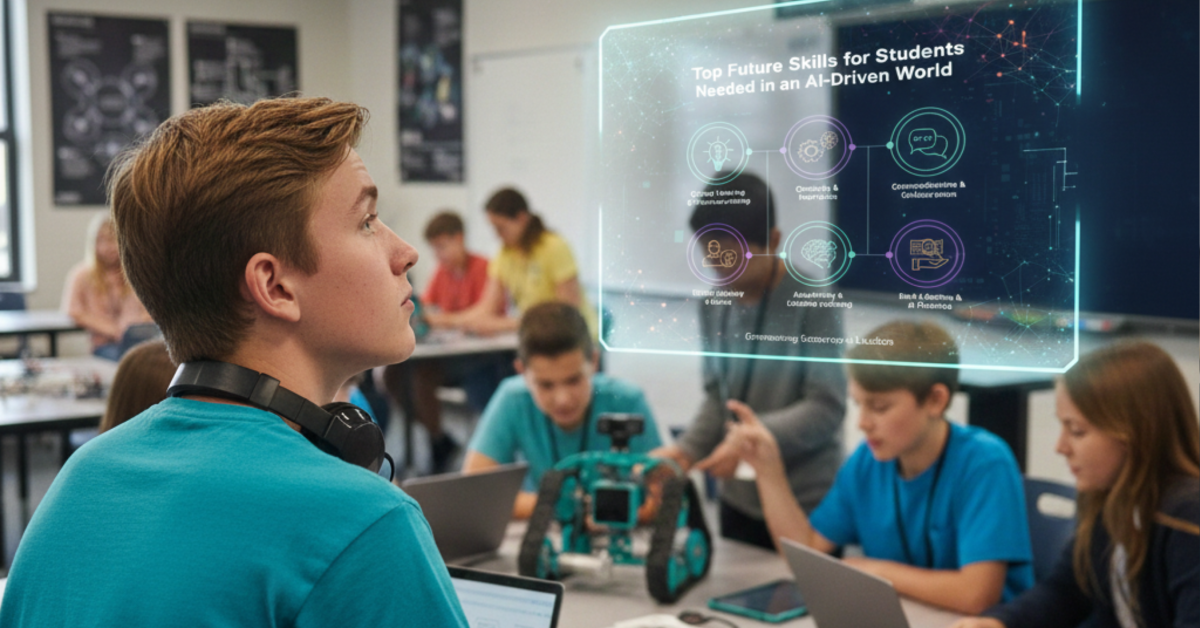
This guide explores the essential competencies students need to succeed in an AI-driven world. We will delve into four foundational pillars that will empower the next generation to become creators, innovators, and leaders in the age of AI. These are the 21st century skills for students that will define their success.
Future Skills for Students: Critical Thinking in Automated Environments
As routine tasks become increasingly automated, the value of uniquely human intelligence skyrockets. The ability to think critically to analyze complex situations, evaluate information from multiple sources, and solve problems that don’t have a clear answer is paramount. In an AI-driven world, critical thinking is not just about finding the right answer; it’s about asking the right questions.
Problem-Solving with AI as a Partner
Future professionals will not be replaced by AI; they will be augmented by it. AI can process vast datasets and identify patterns far beyond human capacity. However, it requires human direction to interpret these findings, understand the context, and make strategic decisions.
Students must learn how to frame problems in a way that AI tools can assist. This involves breaking down complex challenges into smaller components, identifying what data is needed, and using AI-generated insights as a starting point for deeper analysis. For example, a marketing student might use an AI tool to analyze market trends, but it is their critical thinking that will turn that data into a creative and effective campaign strategy. This collaborative approach enhances problem-solving, leading to more innovative and robust solutions.
Ethical Reasoning and Algorithmic Bias
An essential component of critical thinking in the age of AI is ethical reasoning. Algorithms are trained on data created by humans, and they can inherit our biases. Students must develop the ability to question the outputs of AI systems. They need to ask: Where did this data come from? Who might be excluded or negatively affected by this algorithm’s decision?
Educational programs must incorporate discussions about digital ethics, fairness, and transparency in AI. By teaching students to scrutinize automated systems, we empower them to build and advocate for more equitable technology. This is a crucial skill needed in an AI-driven world, ensuring that progress serves all of humanity.
Future Skills for Students: AI Literacy and Understanding the Language of the Future
Just as literacy became essential during the Industrial Revolution, AI literacy is non-negotiable in the fourth industrial revolution. This doesn’t mean every student needs to become a machine learning engineer. Rather, it means every student must possess a foundational understanding of what AI is, how it works, and how to interact with it effectively. AI literacy is one of the most critical future skills for students.
Demystifying the Black Box
AI can often feel like a “black box” a system that provides outputs without explaining its process. AI literacy aims to open that box. Students should learn the basic concepts behind machine learning, neural networks, and natural language processing. Understanding these principles helps them grasp the capabilities and limitations of AI.
Schools and universities can introduce these concepts through accessible, hands-on projects. Using block-based coding platforms or simplified AI model builders, students can train a simple algorithm to recognize images or classify text. This practical experience demystifies AI, transforming it from a magical concept into a tangible tool they can understand and use.
Collaboration and Communication with Intelligent Systems
The future of work involves seamless human-AI collaboration. Students need to develop skills for communicating their intent to AI systems clearly. This is the essence of prompt engineering the art of crafting precise instructions to get the desired output from generative AI models.
This skill extends beyond just text-based commands. It involves understanding how to structure data for machine analysis, how to interpret AI-driven analytics, and how to provide feedback to refine an AI’s performance over time. By integrating these practices into the curriculum, we prepare students to be effective collaborators with the intelligent tools that will define their careers.
Future Skills for Students: Robotics Skills for the AI-Driven World
As AI serves as the brain, robotics provides the body, bringing digital intelligence into the physical world. From automated manufacturing and precision agriculture to robotic surgery and logistics, Industry 4.0 skills are intrinsically linked to robotics. Providing students with hands-on robotics skills is essential for preparing them for a wide array of emerging professions.
From Theory to Hands-On Proficiency
Theoretical knowledge is important, but true understanding in robotics comes from building, programming, and troubleshooting. Robotics programs offer an unparalleled opportunity for project-based learning. Students can design a robot to solve a specific problem, assemble its mechanical components, write the code to control its behavior, and test it in a real-world scenario.
This process integrates science, technology, engineering, and mathematics (STEM) in a dynamic and engaging way. Students learn about sensors, motors, and control systems while also developing crucial skills in teamwork, project management, and perseverance. These experiences build a technical foundation that is directly applicable to careers in engineering, advanced manufacturing, and beyond.
Systems Thinking and Integration
A robot is more than a collection of parts; it is an integrated system where hardware and software work in harmony. Building and programming robots teaches students systems thinking the ability to understand how different components interact to form a cohesive whole.
This holistic perspective is one of the most valuable AI-driven world skills. A professional who understands how a change in software will affect a robot’s mechanical performance, or how a sensor’s limitation impacts data collection, is far more effective than one who only sees their part of the puzzle. Robotics education cultivates this integrated mindset, preparing students to design and manage the complex cyber-physical systems of the future.
Future Skills for Students: Innovation Mindset and Lifelong Learning
The final and perhaps most crucial pillar is an innovation mindset. The rapid pace of technological change means that the specific tools and platforms students learn today may be obsolete by the time they graduate. An innovation mindset is what allows them to adapt, grow, and continuously create value in a state of constant flux.
Cultivating Curiosity and Adaptability
An innovation mindset begins with curiosity a genuine desire to explore, experiment, and learn. Education systems must foster this trait by encouraging students to ask “what if?” and to pursue projects driven by their own interests. This approach, often called inquiry-based learning, moves away from rote memorization and toward creative exploration.
Adaptability is the practical application of curiosity. Students with an innovation mindset see new technologies not as threats, but as opportunities. They are not afraid to learn a new programming language, experiment with a new AI tool, or pivot their approach when a project fails. This resilience is a key differentiator for success.
From Growth Mindset to Creative Confidence
An innovation mindset is built on the foundation of a growth mindset—the belief that abilities can be developed through dedication and hard work. Educators can cultivate this by celebrating effort and learning from failure, rather than focusing solely on correct answers.
When students believe they can grow, they develop creative confidence. They become more willing to take risks, propose unconventional ideas, and challenge the status quo. This is the engine of innovation. In a world where AI can optimize existing processes, the greatest value will come from humans who can envision entirely new ones.
Conclusion: Building Future Skills for Students for a Future-Ready Institution
The integration of AI into every facet of our lives is not a distant future; it is our present reality. For educational institutions, the mandate is clear: we must evolve. The future skills for students critical thinking, AI literacy, robotics proficiency, and an innovation mindset are the cornerstones of a relevant and impactful education.
By embedding these competencies into our curricula, we do more than just prepare students for the job market. We empower them to be the architects of a better future. We give them the tools to solve humanity’s greatest challenges, to create with a sense of purpose, and to lead with wisdom and integrity in an increasingly complex world. As leaders in education, our task is to build the learning environments where these skills can flourish, ensuring our students are not just ready for an AI-driven world, but are prepared to shape it.