Michelle Hollander
Content and Curriculum Lead at Teq
Author
Welcome to the digital world! As technology continues to advance, Artificial intelligence (AI) has infused itself into nearly every aspect of our lives. As such, it is important for students and educators to understand how and why AI is used. In order to prepare learners with future-ready skills, we first need to learn how to responsibly integrate AI into real-world, inquiry-based learning opportunities and solutions.
Here’s a quick guide on how to refresh your teacher resources and provide personalized student learning.
1. Start with the fundamentals
Students should know and understand the basics of AI. AI literacy includes an understanding of what AI is and is not, the different types of tools, best practices for security and responsible use, prompting essentials, limiting bias, and its ever-changing applications. Students will experience enhanced outcomes when they understand effective strategies for handling AI systems and applying inquiry-based thinking skills. Explore Teq’s Edu Resources to learn more and access content on both AI and PBL.
Learn about bias with this AI Literacy interactive on Lumio.
2. Ask questions
When integrating AI into a Project-Based Learning (PBL) experience, it’s important to ask questions. For example, “Has AI been used to create real-world solutions that can be incorporated into a final capstone task?,””How could AI be used to support students in accomplishing/ reaching their desired outcomes?,” and “What technologies do we already have that integrate AI capabilities?” These questions can be useful in understanding how to bridge the gap between AI and PBL.
For instance, students might be exploring energy consumption and engineering a tiny house model. Tiny houses can be simple, but they can also incorporate advanced technologies and transform into a more complex smart home. For instance, security systems can use cameras and sensors powered by AI. AI technology can recognize faces and, therefore, alert owners of strangers within the home. Further, AI can be used within lighting systems, thermostats, virtual assistants, and even for monitoring food inventory.
3. Map it out
Determine when and where students can explore AI functionalities in greater depth. Ideally, students should have time during the research and planning phase of the Engineering Design Process to explore AI fundamentals. Don’t forget to consider how AI might play a role in students’ projects. Students can implement these ideas as they design, construct, and modify their projects during the testing and evaluation phase. Alternatively, if you want students to start their design without AI, you can incorporate it later as an extension.
4. Use an AI kit
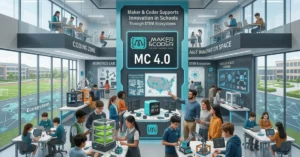
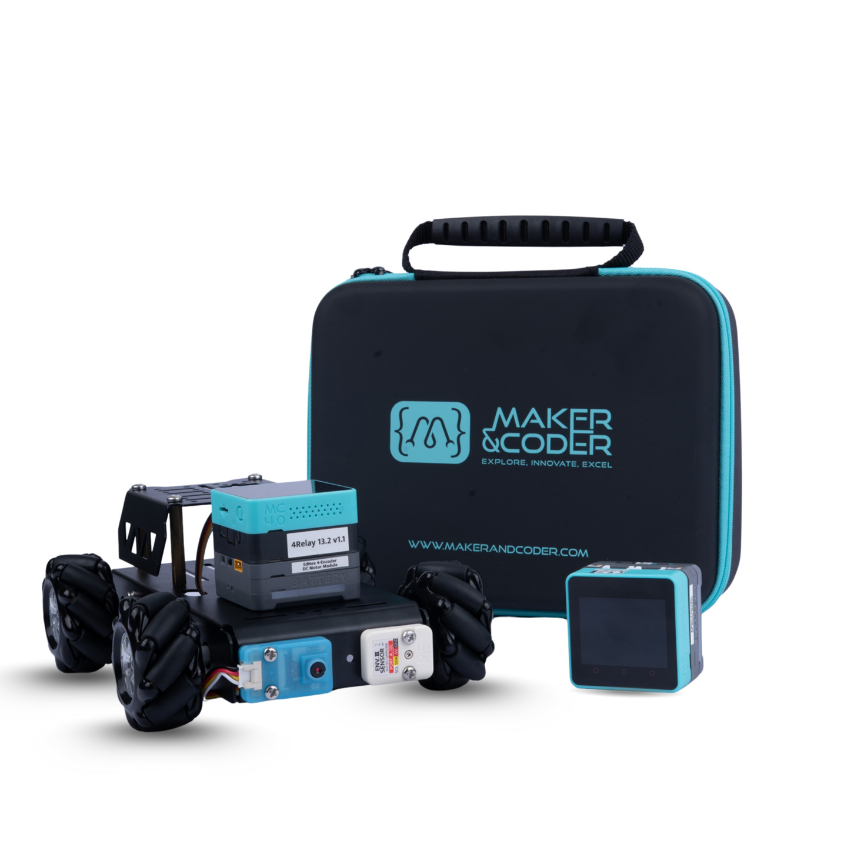
Some products, like the kits from Maker and Coder, have tools to take students’ projects to the next level. The Maker and Coder AIoT Kit features an AI camera, environmental sensors, and even Servo Motors. This enables the capturing and processing of images, remote communication, and location tracking. Having connectivity with the Internet of Things (IoT) also provides students with the ability to explore AI-driven automation and gain advanced coding skills.
Additional sensors can be used for: temperature, humidity, light, color, soil moisture, weight, air quality, motion detection, and heart rate.
Maker and Coder’s MC 4.0 AIoT Kit
5. Know your resources
Pair this type of technology kit with a PBL project, like an iBlock from Teq, and you’ll have everything you need to take learning to the next level! In some cases (like with iBlocks) the curriculum mapping and standards alignment are included with the project, and you can receive support for differentiation and scaffolding.
Additionally, Teach AI provides the latest information on AI in education, including guidance, frameworks, and practical toolkits to further empower you to teach with and about AI. If you are looking for further professional development on the topic, check out the AI Literacy and Instruction mico-credential coming soon to OTIS for educators!
These edtech connections pave the way for career pathway exploration as students experience practical applications and the myriad of ways AI can shape the world around us. Just imagine the unprecedented opportunities these new technologies can uncover. Let’s unlock these possibilities together!
Author Bio
Michelle Hollander
Michelle Hollander is the Content and Curriculum Lead at Teq, where she specializes in creating innovative educational resources that bridge technology and learning. With a passion for empowering educators and students, Michelle focuses on integrating cutting-edge tools like AI into project-based learning to foster critical thinking and future-ready skills. Her work reflects a commitment to making complex concepts accessible and engaging for learners of all levels.