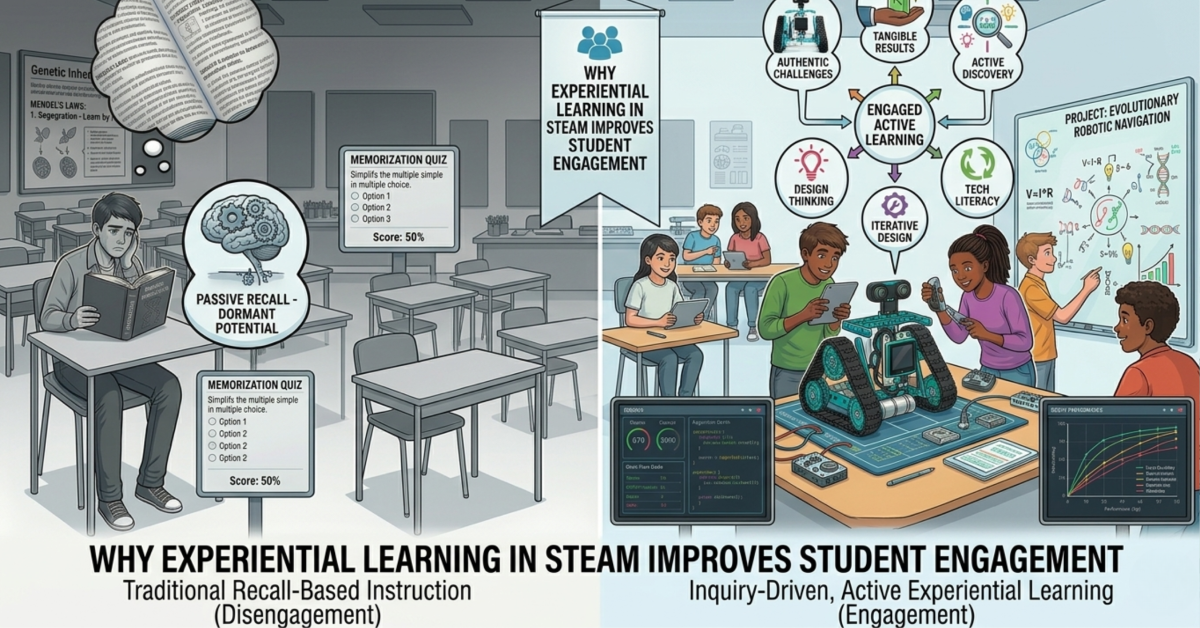
Experiential learning in STEAM transforms passive listeners into active creators. Students learn best when they can touch, build, and experiment with the concepts they study. This hands-on approach directly improves student engagement by making abstract theories tangible. Instead of memorizing formulas from a textbook, students solve real problems. At Maker and Coder, we believe that bringing these concepts to life is the key to building lifelong curiosity.
When educators implement active learning in classrooms, student participation skyrockets. Hands-on STEAM education gives students a clear reason to care about what they are learning. They see the immediate results of their coding sequences or engineering designs. This immediate feedback loop keeps them focused and eager to try again if they fail. Ultimately, interactive STEAM learning creates an environment where making mistakes is just another step toward success.
Here is what you will learn in this guide:
- How experiential learning reshapes traditional education
- Why practical approaches boost student engagement in STEAM
- Key strategies for implementing project-based learning
- Global trends shaping future-ready learning approaches
What is Experiential Learning in STEAM?
Experiential learning in STEAM is the process of learning through direct experience and reflection. It shifts the focus from teacher-led instruction to student-centered discovery. Students engage in practical STEAM education by building robots, writing software, or conducting science experiments. They apply theoretical knowledge to physical or digital projects, cementing their understanding of complex topics.
This method relies heavily on inquiry-based STEAM education. Instead of receiving answers, students learn to ask the right questions. Teachers act as guides rather than lecturers, helping students navigate their own learning paths. When a student asks why a bridge collapsed or a code failed, they must investigate the cause themselves. This builds critical thinking and problem-solving skills naturally.
The Shift Toward Interactive Learning
Interactive STEAM learning replaces rigid curriculum structures with dynamic, adaptable challenges. Students interact with materials, peers, and technology to achieve a specific goal. This interaction creates a multi-sensory learning experience that appeals to different learning styles. Visual, auditory, and kinesthetic learners all find success when they can physically manipulate their projects.
The Core Benefits of Hands-On STEAM Education
Hands-on STEAM education provides undeniable benefits for cognitive and emotional development. The primary advantage is a dramatic increase in knowledge retention. When students physically build a circuit or write a script, the brain forms stronger neural connections. They remember the process because they actively participated in it, rather than just reading about it.
Another major benefit is the development of resilience. Practical STEAM education teaches students that failure is a necessary part of innovation. A robot rarely works perfectly on the first try. By troubleshooting and iterating, students learn to handle frustration and push through challenges. This resilience transfers to other academic subjects and real-world situations.
Boosting Student Engagement in STEAM
Student engagement in STEAM thrives when lessons connect to their personal interests. Project-based STEAM learning allows students to choose projects that matter to them. Whether they want to design a video game or build a solar-powered car, the core STEAM principles remain the same. Autonomy drives motivation, making students eager to dive deeper into the material.
- Higher attendance rates: Engaged students look forward to attending class.
- Better focus: Hands-on tasks require sustained attention, reducing behavioral issues.
- Increased curiosity: Success in one project naturally leads to questions about the next level of complexity.
Building Future-Ready Skills
Future-ready learning approaches prioritize adaptability over rote memorization. The technology landscape changes rapidly, so students must learn how to learn. Experiential learning teaches them how to approach unfamiliar tools and systems with confidence. They become comfortable with ambiguity, a crucial skill for the modern workforce.
Employers actively seek candidates who possess these practical skills. Companies want innovators who can collaborate, communicate, and solve complex problems. By participating in interactive STEAM learning early on, students build a portfolio of these exact competencies. Maker and Coder designs activities specifically to nurture these highly sought-after traits.
How Active Learning in Classrooms Transforms Education
Active learning in classrooms completely redefines the role of the student. Students become active producers of knowledge rather than passive consumers. They collaborate with peers, debate solutions, and present their findings to the class. This dynamic environment mirrors real-world professional settings much closer than traditional lecture halls.
This transformation requires educators to adapt their teaching environments. Desks grouped for collaboration replace isolated rows facing a whiteboard. Classrooms need flexible spaces where students can spread out materials and test their prototypes. When the physical space supports practical STEAM education, student collaboration happens naturally.
Project-Based STEAM Learning
Project-based STEAM learning organizes curriculum around complex, real-world problems. Students spend weeks or months investigating a single challenge from multiple angles. They might research environmental issues, design a technical solution, and build a working model. This comprehensive approach shows students how different STEAM disciplines interlock.
- Math: Calculating dimensions and material costs.
- Science: Understanding the physical properties of building materials.
- Technology: Using software to design and simulate the model.
- Engineering: Assembling the final product safely and effectively.
Inquiry-Based STEAM Education
Inquiry-based STEAM education starts with a compelling question or observation. Students form hypotheses, conduct experiments, and analyze their own data. This mimics the actual scientific method used by professionals. It validates the student’s natural curiosity and empowers them to seek the truth independently.
The Role of the Educator
Educators play a vital role in scaffolding these inquiry-based experiences. Teachers must provide just enough information to get students started without giving away the solution. They ask probing questions that guide students back on track when they get stuck. This delicate balance ensures students feel challenged but not overwhelmed.
Practical Strategies for Interactive STEAM Learning
Implementing interactive STEAM learning requires thoughtful planning and the right resources. Educators and parents should start with simple, low-cost projects to build foundational skills. You do not need expensive equipment to teach basic engineering or coding concepts. Everyday materials like cardboard, tape, and free block-coding software are excellent starting points.
Progression is key to maintaining long-term student engagement in STEAM. As students master basic concepts, slowly introduce more complex tools and languages. Move from visual block coding to text-based languages like Python. Transition from simple craft materials to basic robotics kits and microcontrollers.
Integrating Practical STEAM Education at Home and School
Practical STEAM education should extend beyond the classroom walls. Parents can reinforce experiential learning by encouraging tinkering and exploration at home. Building sets, coding apps, and simple science experiments make excellent weekend activities. Maker and Coder offers numerous resources to help families bridge the gap between school and home.
- Designate a maker space: Create a small area at home dedicated to building and creating.
- Encourage questions: Help children research answers rather than just telling them.
- Celebrate failures: Praise the effort and the learning process when a project breaks.
Simple Activities to Try
You can start applying future-ready learning approaches today with minimal preparation. Try challenging your child to build the tallest tower possible using only spaghetti and marshmallows. This teaches structural engineering and weight distribution. Alternatively, use free online platforms to create a simple animated story, introducing basic coding logic.
Global STEAM Education Trends
Global STEAM education trends show a massive shift toward experiential models. Countries leading in educational outcomes prioritize hands-on learning at all grade levels. Educational ministries worldwide recognize that traditional testing does not accurately measure a student’s ability to innovate. As a result, curricula are evolving to include mandatory coding and engineering modules.
Experiential Learning Worldwide
Experiential learning worldwide takes many different forms based on local resources and cultural priorities. In many European countries, vocational and technical training integrates directly with standard academics early on. Asian nations are heavily investing in robotics and AI education within primary schools. These global approaches prove that interactive STEAM learning is effective across diverse populations.
Implementing Future-Ready Learning Approaches
Future-ready learning approaches demand continuous evolution from educators and institutions. Schools must regularly update their technology and train teachers on new methodologies. Static lesson plans quickly become obsolete in the fast-moving tech sector. Schools need partnerships with industry leaders and brands like Maker and Coder to stay current.
Cross-disciplinary learning is a major component of this future-ready mindset. Modern problems require solutions that blend science, technology, art, and ethics. Integrating arts into STEAM (creating STEAM) encourages creative design thinking. Students who can write elegant code and design intuitive user interfaces will lead the next generation of innovators.
- Focus on adaptability: Teach students to learn new software independently.
- Promote digital citizenship: Ensure students understand the ethical implications of their creations.
- Encourage global collaboration: Connect students with peers worldwide to solve shared problems.
Conclusion
Experiential learning in STEAM is fundamentally changing how students engage with the world. By prioritizing hands-on, practical STEAM education, we prepare students for a complex future. They learn to think critically, collaborate effectively, and bounce back from failure. Active learning in classrooms ensures that education is an exciting journey of discovery, not a tedious chore.
As global STEAM education trends continue to emphasize project-based learning, parents and educators must adapt. We must provide the tools, environments, and encouragement necessary for students to become confident makers. Future-ready learning approaches guarantee that our children will not just consume technology, but actively shape it.
Next Steps with Maker and Coder
Ready to boost student engagement in STEAM? Maker and Coder provides the resources you need to implement experiential learning today. Explore our library of project-based STEAM learning modules designed for all skill levels. Start building, start coding, and watch your students transform into confident innovators.
Frequently Asked Questions
Experiential learning in STEAM is a hands-on approach where students learn by doing. Instead of just reading textbooks, students build, experiment, and solve real-world problems. This method helps them understand complex math and science concepts much faster.
Hands-on STEAM education directly boosts student engagement in STEAM by making lessons fun and tangible. When students physically build a robot or write a piece of code, they see instant results. This keeps them focused, builds their confidence, and helps them remember what they learn for a longer time.
To introduce active learning in classrooms, educators should start with small, collaborative tasks. You do not need expensive gear right away. Try these easy steps:
- Group desks together to encourage teamwork.
- Use everyday items like cardboard and tape for early engineering tasks.
- Ask students questions that guide them to find the answers themselves.
Both are key parts of practical STEAM education, but they have different goals. Project-based STEAM learning tasks students with building a specific solution over time, like designing a bridge. Inquiry-based STEAM education focuses more on asking questions and testing ideas, acting much like a real scientist running experiments.
The modern job market changes quickly, and kids need to adapt. Interactive STEAM learning teaches problem-solving, resilience, and teamwork. By using future-ready learning approaches, we teach students how to think critically and learn new skills, rather than just memorizing old facts.
Recent global STEAM education trends show a massive shift away from standard testing and toward practical skills. Countries leading the way now require coding and engineering in early school grades. You will see experiential learning worldwide as schools realize that creating confident innovators is the best way to prepare for tomorrow.