Building a future-ready STEAM lab equips students with the exact skills they need for modern careers. Schools must transition from traditional desks to dynamic workspaces that foster innovation. This complete STEAM lab setup guide provides everything educators need to launch an effective learning space.
We created this guide at Maker and Coder to simplify the complex process of building a STEAM lab in schools. You will learn actionable steps for space design, equipment selection, and technology integration. Preparing students for tomorrow starts with the environment we build for them today.
What Defines a Future-Ready STEAM Lab?
A future-ready STEAM lab is a highly flexible, technology-rich environment designed for hands-on problem solving. It acts as an innovation hub where students bridge the gap between theoretical science and real-world engineering. This space encourages collaboration, creativity, and critical thinking across multiple disciplines.
The core of a school STEAM laboratory lies in its adaptability to different teaching methods. Teachers can easily shift from lecturing to facilitating group projects within minutes. This flexibility supports diverse learning styles and keeps students highly engaged.
Moving Beyond Traditional Classrooms
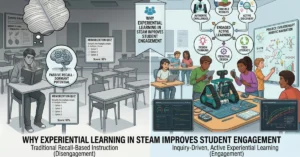
Traditional classrooms prioritize silent, independent work, which limits collaborative innovation. 21st century STEAM learning spaces completely flip this model by prioritizing group interaction and active creation. Students learn by doing, making mistakes, and iterating on their designs.
You will find a distinct difference in the noise level and activity type in a modern lab. Students actively discuss, build, test, and present their work to peers. This vibrant atmosphere mirrors professional engineering and tech environments.
How to Set Up a STEAM Lab: Step-by-Step Guide
Knowing exactly how to set up a STEAM lab prevents wasted budgets and underutilized spaces. The process requires careful planning, starting from educational goals down to the specific chairs you purchase. We break this down into manageable, logical phases.
A successful launch requires input from teachers, administrators, and sometimes even the students themselves. Gaining community buy-in ensures the lab actually meets the specific needs of your school. Follow these foundational steps to guarantee long-term success.
Step 1: Define Your Goals and Curriculum Needs
Your curriculum completely dictates the physical design of your school STEAM laboratory. Before buying a single tool, you must outline what specific skills your students need to learn. A coding-focused lab looks vastly different from a robotics or biotechnology space.
Ask your teaching staff what projects they struggle to execute in traditional classrooms. Use their feedback to build a list of required capabilities for the new space. This targeted approach prevents you from buying flashy technology that ultimately gathers dust.
Step 2: Implement Modern STEAM Lab Design Principles
Modern STEAM lab design relies heavily on modularity and open space. You must maximize floor space to allow students to build large projects or test mobile robots. Avoid built-in furniture that locks the room into a single configuration.
Safety and visibility are critical components of your spatial planning. Teachers need clear sightlines across the entire room to monitor safety during hands-on building. Incorporate plenty of clear storage and organized tool walls to keep the space clean.
Flexible Furniture and Layouts
Mobile furniture is the absolute backbone of a successful lab setup. Desks, chairs, and whiteboards should feature heavy-duty casters for quick reconfiguration. Key furniture requirements include:
- Height-adjustable tables to accommodate both sitting and standing work.
- Nesting chairs that easily tuck away to clear floor space.
- Mobile storage carts that bring materials directly to student workstations.
Creating Dedicated Collaboration Zones
Students need specific areas designed purely for brainstorming and teamwork. These collaboration zones should feature soft seating, large writable surfaces, and screen-sharing technology. Separating the “messy” building areas from the “clean” planning areas keeps projects organized.
Step 3: Select STEAM Lab Equipment for Schools
Purchasing STEAM lab equipment for schools requires balancing your budget with your educational goals. Start with versatile, durable basics before investing in highly specialized, expensive machinery. Maker and Coder strongly recommends building a strong foundation of hand tools and basic electronics first.
Your equipment list should scale with the age and experience level of your students. Elementary schools might focus on simple circuitry and building blocks. High schools require advanced manufacturing tools and professional-grade software.
Basic Tools and Electronics Foundational Kits
Every future-ready space needs a robust supply of basic hand tools and electronic components. These foundational items allow students to prototype quickly and learn core engineering concepts safely. Essential starting items include:
- Precision screwdrivers, pliers, and wire strippers for mechanical assembly.
- Multimeters and soldering stations for electrical work and diagnostics.
- Microcontrollers (like Arduino or micro:bit) to introduce physical computing.
- Various sensors, motors, and LEDs for bringing static projects to life.
Advanced Robotics and 3D Printing
Once the basics are covered, you can introduce advanced fabrication and automation tools. 3D printers and laser cutters empower students to manufacture their own custom parts on demand. These machines bridge the gap between digital design and physical reality.
Robotics kits provide an incredible platform for teaching programming, mechanics, and system integration simultaneously. Students can build rovers, robotic arms, or automated sorting machines. This equipment turns abstract coding concepts into visible, physical actions.
Maker and Coder Recommendations
At Maker and Coder, we emphasize choosing open-source platforms whenever possible. Open-source hardware generally offers better community support, lower costs, and greater long-term flexibility. We advise schools to purchase multiple budget-friendly 3D printers rather than one expensive unit, ensuring more students get hands-on time.
Creating a Smart STEAM Classroom Setup
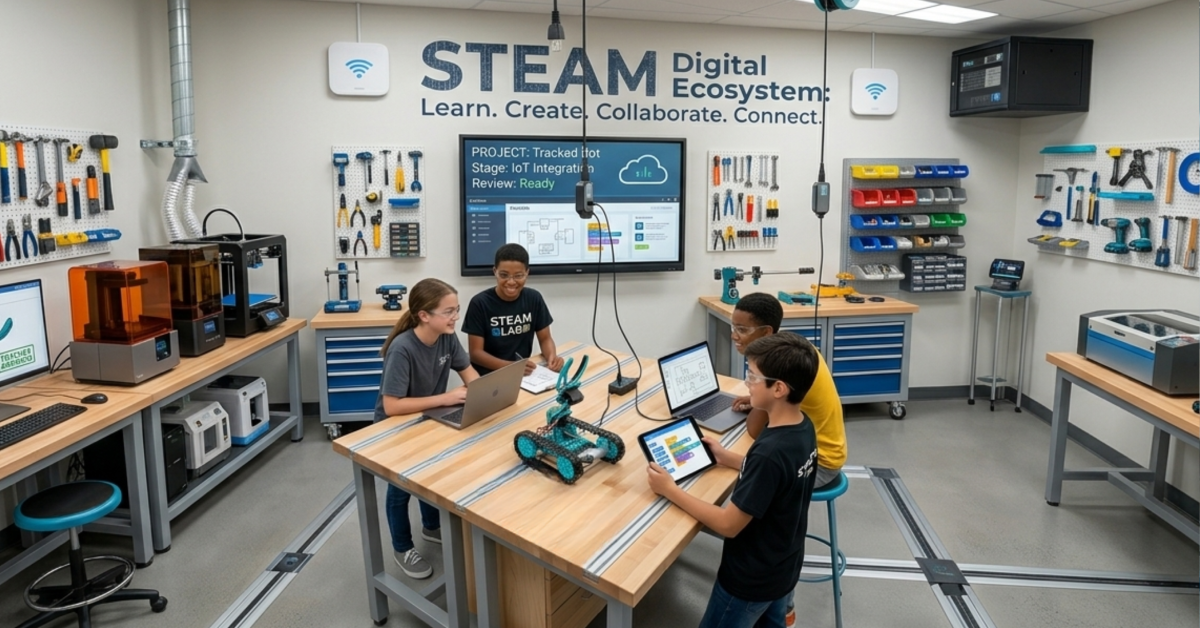
A smart STEAM classroom setup integrates the physical lab with digital learning ecosystems. High-speed internet, cloud storage, and device management systems are just as important as the physical tools. This digital infrastructure allows students to collaborate on code and designs from anywhere.
Power management is a frequent oversight in smart classroom planning. Ensure you install ceiling-mounted power drops or abundant floor outlets to prevent tripping hazards from extension cords. Every student device, robot, and laptop needs reliable access to charging.
Integrating IoT and Digital Tools
Integrating the Internet of Things (IoT) directly into the lab environment provides incredible learning opportunities. Students can build sensors that monitor the lab’s temperature, air quality, or tool usage. This turns the classroom itself into an interactive, ongoing science experiment.
Digital portfolios and cloud-based CAD software allow students to document their progress effectively. Teachers can easily review digital designs before allowing students to use expensive 3D printer filament. This seamless digital workflow maximizes efficiency and minimizes waste.
Global Trends: STEAM Lab Setup Worldwide
Observing STEAM lab setup worldwide reveals a massive shift toward interdisciplinary learning environments. Countries leading in education are abandoning siloed subjects in favor of comprehensive, project-based learning. Global trends clearly show that the most successful labs mimic professional startup environments.
Schools across Europe and Asia are heavily investing in artificial intelligence and green technology workstations. They are equipping labs with tools to study renewable energy, smart agriculture, and machine learning. These global trends dictate the skills our students will need to compete internationally.
Insights from International School STEAM Labs
International school STEAM labs often serve as the testing ground for cutting-edge educational models. These institutions frequently partner with local tech companies to ensure their curriculum matches industry needs. We can learn valuable lessons from their aggressive adoption of new technologies.
One major takeaway from international schools is the emphasis on “failure as a feature.” Their labs are designed specifically for rapid prototyping, where breaking a design is part of the learning process. They stock abundant, cheap raw materials like cardboard and balsa wood to encourage fearless experimentation.
Funding and Sustaining Your School STEAM Laboratory
Securing the budget for a school STEAM laboratory is often the biggest hurdle for administrators. However, a well-planned lab is an incredible asset that frequently attracts outside funding. You must frame your lab as a community workforce development tool, not just a classroom.
Sustaining the lab requires an ongoing budget for consumable materials like 3D printer filament, batteries, and craft supplies. You must factor these recurring costs into your initial planning phase. A beautiful lab becomes useless if teachers cannot afford the basic materials to run projects.
Grants, Sponsorships, and Community Partnerships
Countless grants exist specifically to fund 21st century STEAM learning spaces in public and private schools. Government initiatives, corporate tech giants, and local educational foundations regularly issue STEAM funding. Effective funding strategies include:
- Applying for federal and state STEAM initiative grants tailored to workforce readiness.
- Partnering with local engineering or manufacturing firms for equipment donations or mentorships.
- Hosting community maker nights to showcase student work and raise localized funds.
Conclusion: Building the Future with Maker and Coder
Designing a future-ready STEAM lab is an ongoing journey of adaptation and improvement. By following this STEAM lab setup guide, you lay a resilient foundation that will serve students for decades. Focus on flexibility, robust basic tools, and a curriculum driven by real-world problem solving.
At Maker and Coder, we are dedicated to helping educators navigate this exciting transition. We provide the resources, project ideas, and guidance needed to bring these spaces to life. Start planning your lab today, and give your students the exact tools they need to build tomorrow’s world.
Frequently Asked Questions (FAQ)
A future-ready STEAM lab is a highly flexible, technology-rich environment designed for hands-on problem-solving. It moves away from traditional desks to create dynamic 21st century STEAM learning spaces where students collaborate on real-world projects. At Maker and Coder, we see these labs as essential innovation hubs that bridge the gap between abstract science and practical engineering.
Knowing exactly how to set up a STEAM lab starts with defining your curriculum goals before purchasing any tools. Consult with your teachers to understand what specific projects they want to run in your new STEAM lab in schools. Following a comprehensive STEAM lab setup guide ensures your budget aligns directly with your educational objectives and prevents wasted resources.
Flexibility and open space are the absolute foundations of modern STEAM lab design. You must prioritize mobile furniture, height-adjustable tables, and heavy-duty casters to allow quick room reconfigurations. A highly adaptable school STEAM laboratory enables teachers to shift seamlessly from group brainstorming to active, messy prototyping.
Always start with versatile, durable basics when selecting STEAM lab equipment for schools. Build a strong foundation first, then scale up to advanced robotics or 3D printers.
- Basic hand tools: Screwdrivers, wire strippers, and pliers for mechanical assembly.
- Electronics kits: Multimeters, microcontrollers, and sensors to teach physical computing.
- Digital infrastructure: Reliable Wi-Fi and power drops for a true smart STEAM classroom setup.
Observing STEAM lab setup worldwide reveals a massive global shift toward interdisciplinary, project-based learning environments. International school STEAM labs frequently partner with local tech companies to align their curriculum directly with modern industry needs. These global trends show that successful labs embrace rapid prototyping and view failure as a critical part of the learning process.