Why Education Must Evolve
Education stands at a critical juncture. For decades, the standard model of schooling involved rows of desks, a teacher at the front, and students absorbing information to be repeated later on a test. While this method served the industrial age well, it is no longer sufficient. The rapid advancement of technology, automation, and global connectivity has fundamentally shifted what society requires from its future workforce.
We are moving away from an economy based on knowledge retention and toward one based on knowledge application. In this landscape, hands-on learning is not merely an enrichment activity or a fun break from “real” work. It is the engine of modern pedagogy.
21st century classrooms must evolve to become laboratories of innovation. They need to be spaces where failure is analyzed, creativity is structured, and theoretical concepts are physically constructed. This shift requires a move toward experiential learning in classrooms, supported by robust tools and thoughtful curriculum design.
Moving Beyond Passive Instruction: The Shift to Active Learning
The traditional lecture format assumes that all students learn at the same pace and in the same way. It treats the learner as a passive vessel waiting to be filled with facts. However, cognitive science suggests that deep understanding comes from engagement, not just listening.
Active Learning Strategies That Make a Difference
- Performing science experiments to see concepts in action
- Writing and debugging computer code rather than only reading about programming
- Building mechanical models to demonstrate scientific or engineering principles
- Participating in real-world simulations and problem-solving scenarios
The goal is to transform students from consumers of information into creators of solutions. This is where the distinction between “knowing” and “doing” disappears. In a biology class, knowing the parts of a skeleton is useful. But understanding how those bones function as a system of levers and pulleys and perhaps building a mechanical model to demonstrate it is transformational.
Making Abstract Concepts Real: Experiential Learning in Classrooms
One of the greatest challenges in education is bridging the gap between abstract theory and real-world application. Students often ask, “Why do I need to learn this?” It is a valid question. Without context, algebra equations and physics formulas remain floating abstractions.
Experiential learning in classrooms answers that question by grounding abstract concepts in tangible reality.
Key Benefits of Experiential Learning
- Applies theoretical knowledge to practical projects
- Offers opportunities to experiment and iterate
- Encourages learning from mistakes
- Connects classroom content to real-world challenges
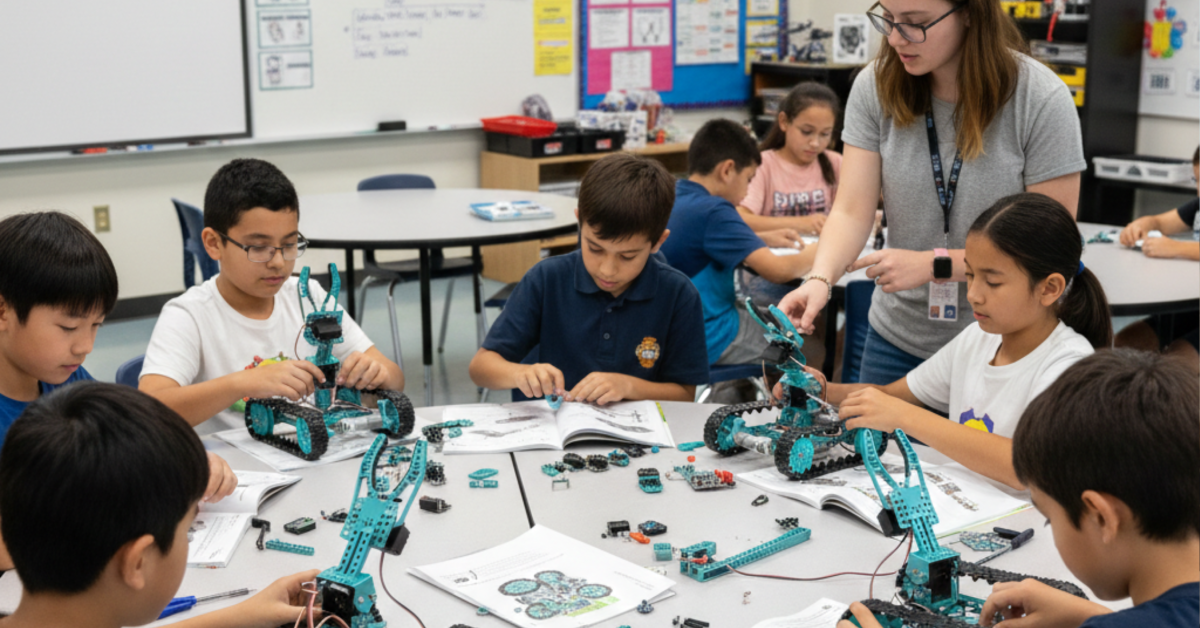
When a student uses a robotics kit to build an autonomous vehicle, they aren’t just playing with plastic and wires. They’re applying geometry, physics, and logic in a hands-on context.
Product Spotlight: maker and coder STEM Kits
maker and coder proudly offers classroom-ready robotics and coding kits that make hands-on learning seamless for teachers and inspiring for students.
Features of Our Kits
- Step-by-step project-based instructions: Perfect for building confidence in new learners
- Modular design: Enables easy customization and experimentation
- Curriculum-aligned activities: Ensures every project supports learning goals
- Teacher support: Comprehensive guides and lesson plans to simplify implementation
Structured tools from maker and coder serve as an innovation platform, not just a set of parts. They help teachers bring hands-on STEM education to life in 21st century classrooms.
The Power of Project-Based Learning: From Idea to Innovation
To truly prepare students for the future, schools are increasingly adopting project-based learning (PBL). Unlike traditional units that end in a multiple-choice exam, PBL units conclude with a student-designed product or solution.
How Project-Based Learning Works
- Identify a real-world problem
- Collaborate with peers to brainstorm solutions
- Design and prototype a model
- Test, fail, analyze, and iterate
Sample Project Ideas with maker and coder Kits
- Building an autonomous robotic vehicle
- Designing a smart energy-saving device
- Creating an IoT-based environmental monitor
- Developing coding-based solutions for local schools
Through modular kits by maker and coder, students gain tools to bridge theory and practice all while developing research, engineering, and presentation skills.
Building In-Demand Skills: The Goal of Skill-Based Education
The World Economic Forum and leading educational bodies agree: tomorrow’s jobs demand problem-solving, critical thinking, and creativity skills hard to cultivate through memorization alone.
Core Competencies Developed Through Hands-On Learning
- Analytical and computational thinking
- Technical fluency and confidence with devices
- Teamwork and effective communication
- Adaptability and resilience through iteration
maker and coder kits are designed to support skill-based education by targeting these essential competencies, making hands-on learning accessible and effective worldwide.
Global Momentum: 21st Century Education Worldwide
Education reform is a global movement. From pioneering maker spaces in Finland to STEM innovation labs in Singapore, school systems are investing in hands-on learning.
Trends in Global STEM Education
- Early introduction to robotics and coding
- Integration of maker spaces and innovation labs
- Collaboration between international schools and technology partners
- Emphasis on project-based, applied learning across diverse cultures
Institutions around the world choose maker and coder to equip students with the tools and experience necessary for a rapidly changing technology landscape.
Confidence Through Creation: The Personal Benefits of Hands-On Learning
While academic skills are vital, confidence and agency are often the greatest outcomes of hands-on projects.
How Experiential Learning Builds Confidence
- Reduces fear of failure by normalizing iteration
- Instills a sense of ownership by letting students create
- Offers alternative ways to excel for students with different strengths
- Fosters intrinsic motivation through tangible achievement
Structured, guided platforms like maker and coder open opportunities for every student to shine regardless of learning style.
Supporting Teachers: Making the Transition Seamless
Switching to an active, experiential approach can feel overwhelming for educators. maker and coder is dedicated to supporting this shift.
How Our Classroom Solutions Help Teachers
- Plug-and-play kits integrate with existing curricula
- Detailed lesson pathways simplify planning
- Flexible activities meet diverse classroom needs
- Comprehensive teacher resources minimize prep time
Our goal: empower teachers to become facilitators of creative learning, not just lecturers.
The Future Is Built, Not Memorized
The classrooms of the future will not be defined by devices alone, but by what students do with them. Passive consumption is being replaced by active creation.
By embracing hands-on learning, supporting experiential and project-based education, and partnering with makers of structured tools like maker and coder, educators worldwide are preparing generations who can build, innovate, and thrive.